Every return puts revenue you have earned at risk. In May 2026, merchants on Synctrack Returns & Exchanges handled more than $1.32M in return value. Instead of paying all of it back as refunds, they kept a large share of it in the store. This recap shows how return activity became recovered revenue, where that money came from, and why May was about keeping more, not handling more.
Contents
May 2026 was a smaller month for return value and a stronger month for outcomes. Total return value fell from April. But Synctrack merchants kept a bigger share of each return dollar and turned more exchanges into new sales. The result: less revenue at risk, and more of it saved.
Here are the numbers that defined the month:
A return is the moment a sale you made becomes uncertain. In May 2026, merchants handled a large volume of returns: About 10,500 requests covering 17,000+ items, worth $1.32M in product value. Without a plan, each request moves toward a cash refund. That puts the full $1.32M at risk of leaving the business.
This is the starting point for any returns plan: a known pool of revenue at risk. Customers will return items. The question is what happens next.
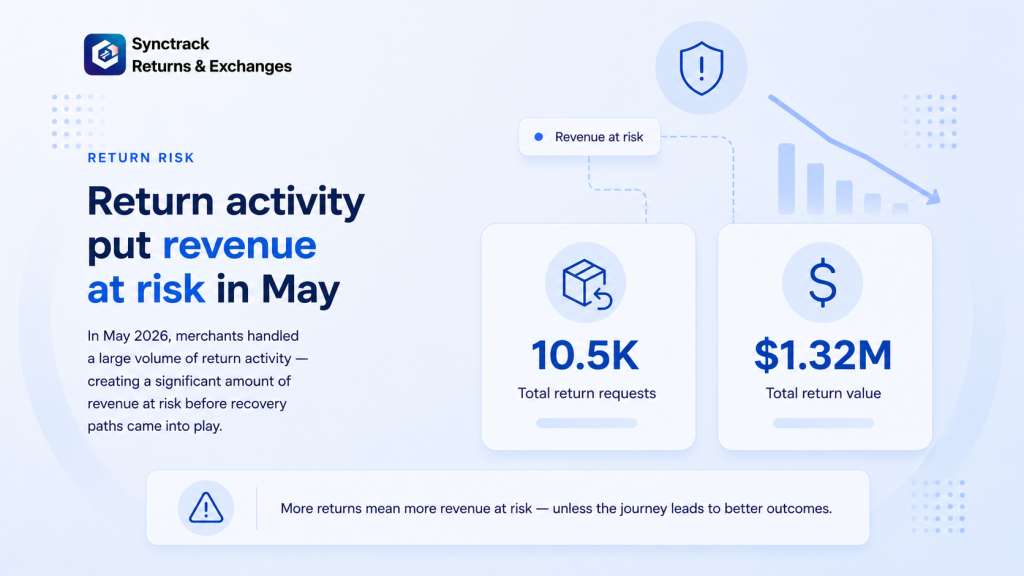
👉 More returns mean more revenue at risk, unless the return journey guides customers toward exchanges, store credit, and other in-store outcomes before a refund is the only choice.
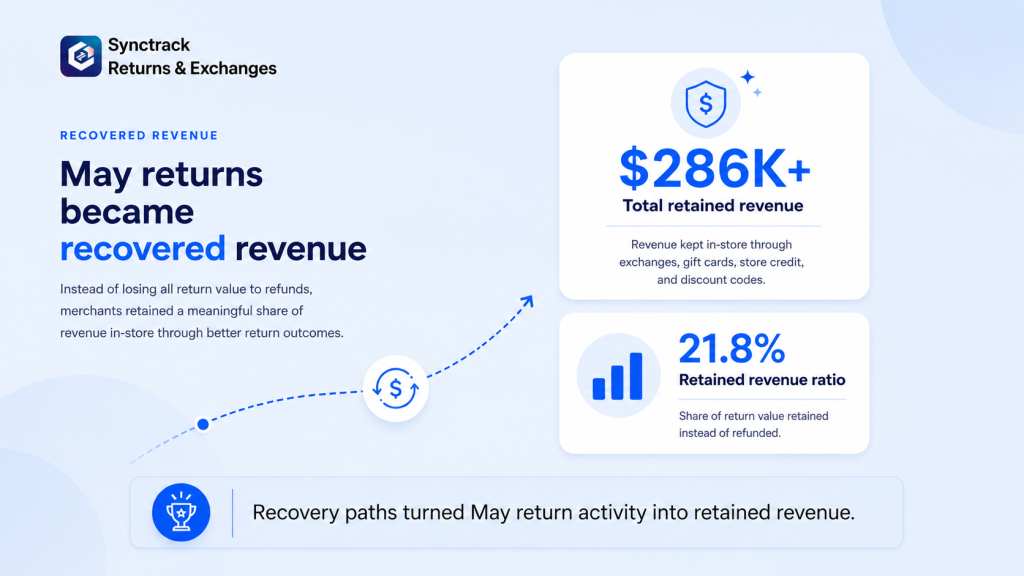
Instead of losing all of that return value to refunds, merchants kept a large share of it in-store. In May, Synctrack merchants recovered $286k+. This is revenue kept inside the business through exchanges, gift cards, store credit, and discount codes, not paid back as cash.
The number to watch is the ratio, not the dollar figure. The retained revenue ratio rose to 21.8% in May, up from 16% in April. There was less return value to work with, yet merchants kept a larger slice of each return dollar. That is the gap between a process that records refunds and one that redirects them.
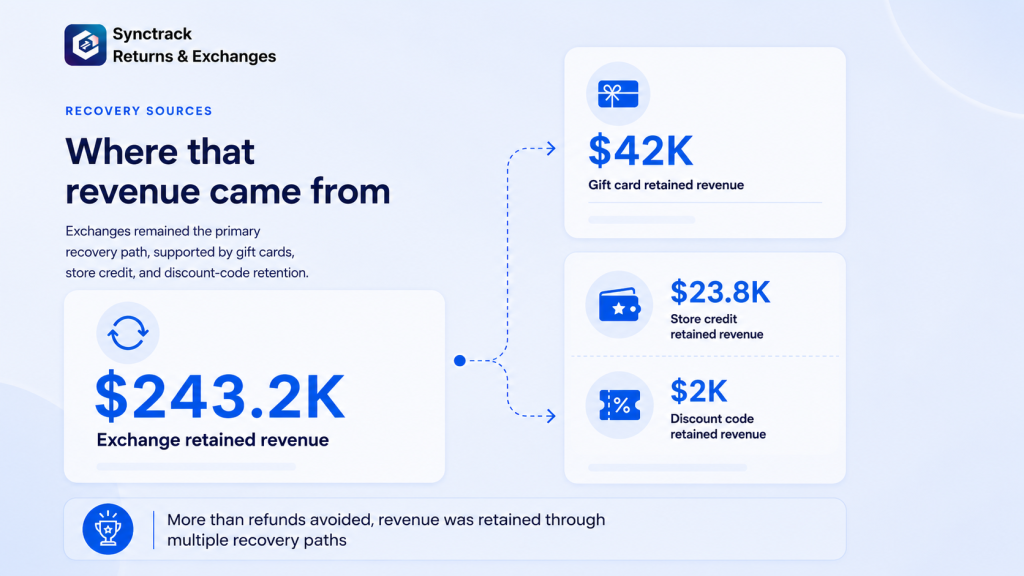
Retained revenue is not one lever. It is four. Synctrack Returns & Exchanges lets merchants offer exchanges, store credit, gift cards, and discount codes in place of a straight refund. Here is how the $286K broke down in May:
| Recovery path | Revenue retained (May) | What it is |
| Exchanges | $243.2k | Value kept when customers swapped items in place of a cash refund. |
| Gift cards | $42k | Value kept when customers chose a gift card over a cash refund. |
| Store credit | $23.8k | Value kept when customers chose store credit over cash back. |
| Discount codes | $2k | Value kept when customers took a discount code in place of a refund. |
Exchanges did most of the work, at about 85% of all retained revenue. The signal is clear: when the return journey makes a swap easy, most customers choose to keep shopping with you over taking their money and leaving.
Recovery keeps revenue you had. Upsell adds revenue you did not. In May, returns did more than recover value. Merchants turned exchanges into new sales.
When a customer exchanges for a higher-priced or add-on item and pays the difference, that is an upsell from a return. In May, those upsell exchanges brought in $33,5k in extra revenue. That is close to triple April’s $12,017.82.
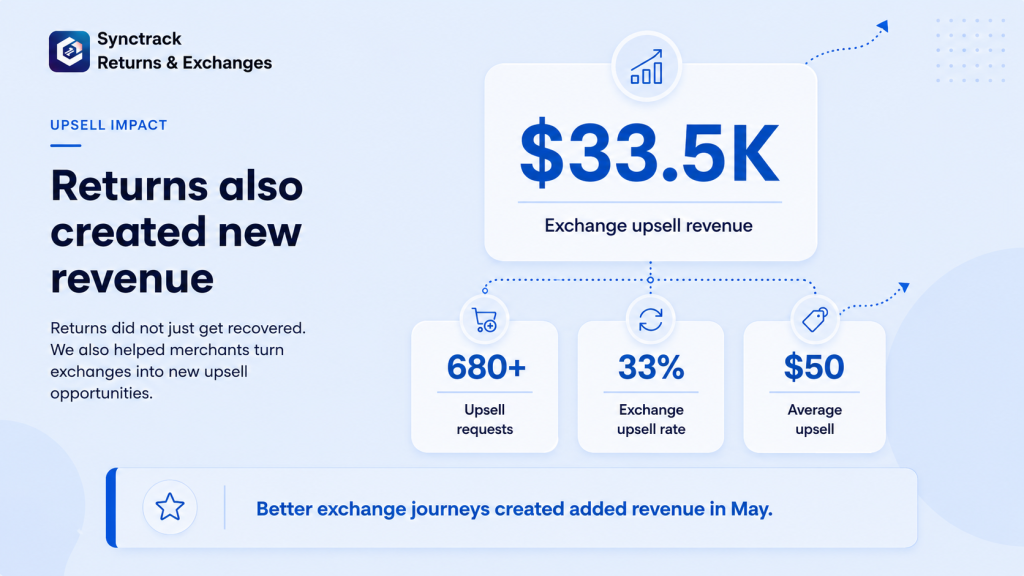
Each gain builds on the last. A higher upsell rate, on more requests, at a larger average value: that is why exchange upsell revenue grew 178% month over month. Better exchange journeys did more than save revenue in May. They created it.
Strong recovery and upsell numbers matter when a small team can keep up. In May, automation handled the routine work, so merchants could grow returns without adding staff.
💡 The pattern is simple: automation removes manual approvals and status updates, return tracking removes the “where is my return?” tickets, and your team gets time for the moments that move revenue – the exchanges and upsells.
May made a point that is easy to miss when you watch total return value alone: the size of your return pool matters less than what you do with it. The takeaways:
May’s results came from a return flow built to guide customers toward exchanges, store credit, gift cards, and upsells, backed by automation that keeps it running. If your store sends returns straight to refunds, that is revenue leaving the business each month.
Keep more of what you have earned with Synctrack Returns & Exchanges, the returns app that turns return risk into recovered and new revenue.