Cost of returns is one of the highest and most misunderstood costs in ecommerce. Many online retailers treat them as a fixed cost, like a tax you pay for selling online. But the smartest Shopify merchants see returns differently. To them, a return is a signal, a process, and a chance to win the customer back. This guide breaks down what returns really cost, where your money goes, and the exact steps that turn refund requests into exchanges, upsells, and repeat buyers.
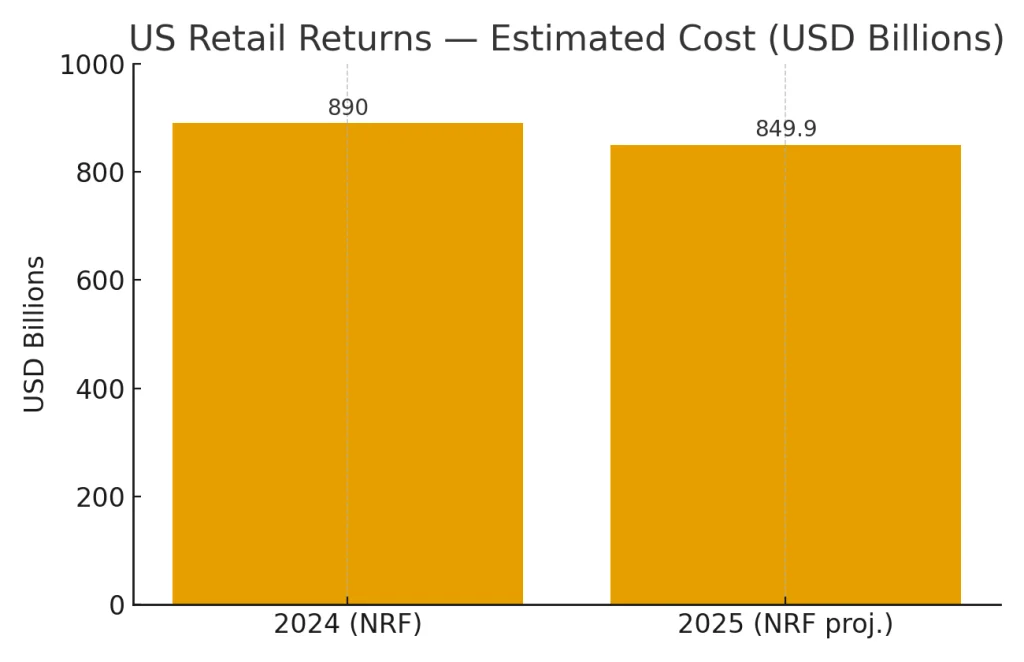
The numbers are hard to ignore. U.S. retailers expected $849.9 billion in merchandise returns in 2025. That works out to a 15.8% return rate. It is down a little from $890 billion and 16.9% in 2024, but it still ranks as the second-highest total ever recorded. That single year of returns is worth more than the entire economy of most countries.
 Online stores carry most of this weight. The National Retail Federation and Happy Returns report that about 19.3% of all online sales come back, compared to only 5% to 8.9% in physical stores. So roughly one in five online orders gets returned, and each one costs far more than the price you refund.
The problem is also getting worse. Return fraud hit $76.5 billion in losses in 2025, nearly tripling from past years. Also, about 9% to 15% of all returns are now thought to be fraudulent. But fraud is only part of the story. The real damage hides inside the reverse logistics chain that every honest return must pass through.
Most merchants look at the refund amount when they add up return costs. That is the wrong number. The true cost to process a return is $27–$41 per item on average, according to Radial and industry analysis, with DTC apparel brands frequently hitting $40+. That is about 3 times what most founders guess.
Here are the 6 layers that make up the cost:
Across the industry, processing a return costs 20% to 65% of the item’s original value, depending on the category. At a 12% return rate on $100,000 a month in revenue, processing alone costs about $81,000 a year, and that is before you count lost inventory value. From the source above, Deloitte estimates that returns can add up to around 10% of a company’s total yearly turnover once you include every piece.
Not every product bleeds the same. Return rates swing widely by category, and knowing where your store sits is the first step toward cutting costs.
| Product category | Typical online return rate |
| Apparel | 20–40% |
| Footwear | 17–30% |
| Home and furniture | 15–23% |
| Auto parts | About 19% |
| Electronics | 8–15% |
| Accessories and jewelry | 12–15% |
| Beauty and personal care | 4–12% |
This table was last updated on 10/06/2026
Apparel sits at the top for a reason. Fit and sizing are the number one cause of returns, behind up to 70% of clothing returns. A linked habit called bracketing makes this worse. Shoppers order several sizes or colors, plan to keep one, and send the rest back. This is now normal for most online buyers. In the UK, returns hit 17.5% of all online orders in 2025, the highest rate in the world, while exchanges made up only 5.8% of that volume. That gap is a clear opportunity most merchants have not captured yet.
Beyond the direct costs, returns create second-order expenses that rarely show up on a profit-and-loss statement but quietly drain your margin.
Inventory stuck in limbo. A returned item is not revenue until you inspect, repackage, and restock it. That process can take days or weeks. During that time, the inventory earns nothing and cannot be sold. For seasonal goods, an item that comes back in August may be useless by September.

Cash tied up. Sender Shamiss, CEO of ReturnPro, points out that retail returns are now a massive $850 billion problem. A huge chunk of that is inventory sitting in a warehouse corner, waiting to be inspected and brought back to life. That is real money that merchants cannot put to work.
Markdown losses. Items that come back damaged, worn, or opened cannot be sold as new. Liquidation, donation, and refurbishment all cost extra on top of the return, and they rarely recover the full product cost.
Overhead that does not shrink. Statista puts inspection, sorting, and repackaging at $10 to $40 per returned item. A warehouse built to ship 500 orders and receive 100 returns a day carries that fixed overhead no matter the volume.
Returns eat into profit fast, but most of that cost isn’t fixed. With the right setup, you can stop many returns before they happen and turn the rest into sales you keep. Here are 6 strategies that cut return costs without scaring customers away.
The best return is the one that never happens. Most returns you can prevent come from three things: unclear product info, bad photos, and size or fit surprises. You can fix all three.
Make your product pages better. 360-degree photos cut clothing returns a lot by giving shoppers a true sense of scale and detail. Independent platform data from Shopify shows that merchants using interactive 3D and 360-degree models reduce their return rates by up to 40%. Academic studies confirm this happens because rotatable images increase “visual diagnosticity”- giving buyers the sensory vividness they need to know exactly what they are getting, which prevents the “not what I expected” returns. A/B tests on major retailers like Home Depot have shown a 35% drop in returns after implementing 360-degree spins. Here’s what helps:
Write honest descriptions. Overpromising is a top reason for “not as described” returns. List the exact materials, sizes, and weights. Be clear about what the product can’t do.
Send helpful emails after the sale. A thank-you email with care tips, a shipping update with the right delivery date, and an arrival email with usage tips all ease buyer’s regret. These returns come from doubt, not a broken product. The emails cost almost nothing and answer worries before they turn into returns.
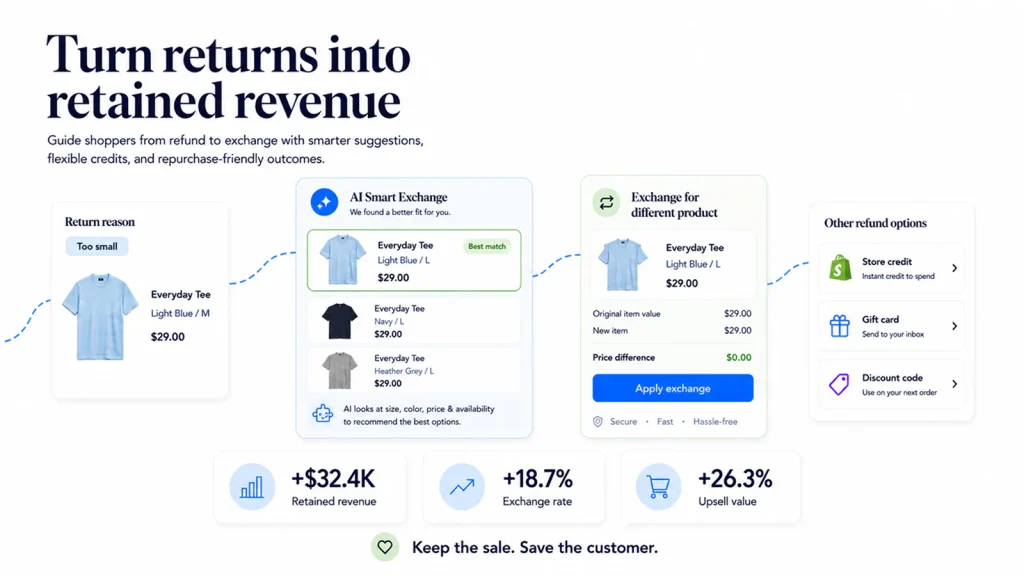
When a customer starts a return, most merchants default to a one-click refund. That is a missed sale. The customer is already engaged, already logged in, and still thinking about your product. An exchange-first approach reframes this moment.
Show exchange before refund. When a customer picks an item to return, your portal should make exchange as the main path and list refund as the backup. This simple change shifts behavior. Placing the exchange button above the refund button converts requests without any extra friction or cost.
Use return-reason data to recommend products. If a customer bought shoes that ran small, the portal should pull the next size up from current stock. If they did not like the style, it should show similar products that shoppers with the same taste loved. In fact, 60-61% of consumers wish it were easier to exchange an online order, so the demand for a smooth exchange is already there.
Add bonus store credit to tip the choice. A small bonus, such as $10 of extra store credit, is cheap insurance against a full cash refund. Offering $10 in extra credit instead of a $120 refund is simple math. Research shows 68% of customers are more likely to buy again after store credit, compared to 45% to 50% after a cash refund. The best returns programs convert 30 to 45%, depending on implementation.
Charge a small fee on refunds, keep exchanges free. Ana Luisa charges $6.99 on refunds while keeping exchanges free, paired with free shipping on exchanges, gently steers customers toward the better outcome. Around 66% to 73% of retailers in the U.S., UK, and Australia now charge a return fee.
The returns flow is one of the most wasted upsell spots in ecommerce. Customers who are actively dealing with your brand, even in a negative moment, respond better to relevant offers than cold visitors do.
Run a return-reason survey, then show better options. A quick multiple-choice survey at the start of a return tells you exactly what went wrong. Then your portal can surface products the customer actually wants: a higher-quality version of the returned item, a matching product they viewed but did not buy, or a bundle that solves the real need.
Use purchase history for cross-sells. A customer processing a return may want to keep other items from the same order. Recommending products based on what they have liked before is a warm-context cross-sell, far stronger than a generic email blast.
Time your emails around the return. Return emails open at much higher rates than normal retail emails. Adding a relevant product suggestion to return confirmations, shipping-label emails, and refund notices creates several touchpoints where customers are already paying attention.
For cheap items, the return math is upside-down. If a $20 product costs you $8 to make, and return shipping plus restocking costs $13, then processing the return destroys value. The item costs more to get back than it is worth.
A returnless refund policy is the fix. You refund the customer and tell them to keep or donate the item. Most merchants set this for products under $25 to $50. Applied carefully, based on product value, return reason, and customer history, returnless refunds wipe out the processing cost while keeping customers happy.
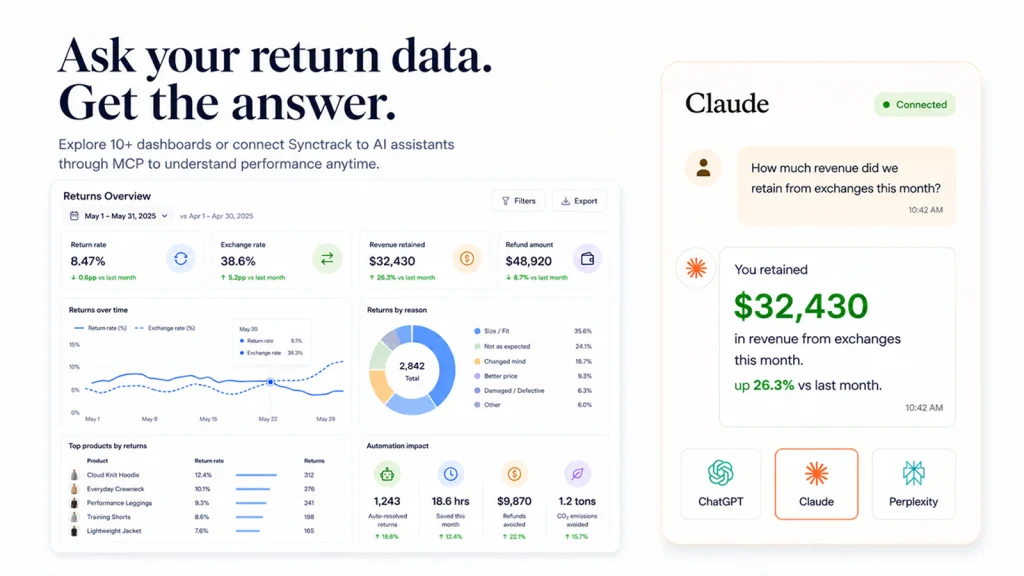
Return rates are not spread evenly. Tracking returns at the SKU level, not just in total, turns return management from a finance headache into a product-improvement loop.
Ask these questions of your data:
Once you can see the patterns, fixing them becomes a clear project. Update descriptions for content-driven returns, improve packaging for damage-driven returns, and rewrite ad copy that sets the wrong expectations.
If your return rate is 12%, you should price your products knowing that 12% of units will come back at $40 to $50 each. The formula for the per-unit return reserve is:
Reserve = (Return Rate × Average Cost Per Return) ÷ (1 − Return Rate)
At a 12% return rate and $45 per return, that comes to about $6.14 per unit you should build into pricing to cover processing. This is not a price hike. It is honest cost accounting. Merchants who skip this reserve are quietly selling products below their true cost.
There is a real tension here. Tighten your return policy too much, and you scare customers away. Keep it too loose, and you invite abuse. The data settles this clearly in favor of being generous, with the right guardrails.
92% of customers say they will buy again if returns are easy, and from a Journal of Marketing peer-reviewed study: free returns increased customer spending by 158% to 457% higher over the observation period, compared to customers charged for returns who reduced spending by 75%–100%.
The smart move is not to kill free returns. It is to set up incentives so that exchanges and store credit become the favored outcome for both sides. A policy that is generous on exchanges but charges a small fee on cash refunds keeps customers loyal while protecting your margin.
A longer return window of 45 to 90 days can actually lower returns. It removes the rush to send something back “just in case” and gives customers time to commit. Free returns are offered only to loyalty members, since the extra purchases from those members more than cover the cost.
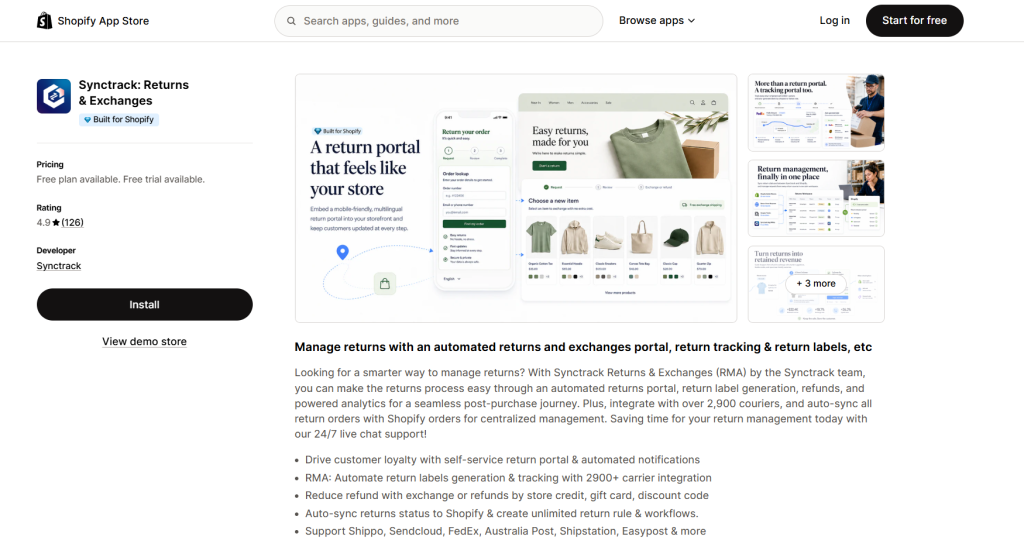
The strategies above work. The question is execution – and that’s where most merchants lose the gains they planned for.
Most store owners are still approving return requests one by one, making labels by hand, chasing tracking numbers, and processing refunds late at night. Every manual step costs time, every slow refund risks a one-star review, and every default cash refund gives away a sale that could have stayed in your store. Do that across hundreds of orders a month, and returns quietly eat 15%–20% of the revenue you were trying to protect.
Synctrack Returns & Exchanges automates the entire flow – labels, refunds, exchanges, and analytics – inside one portal that connects directly to Shopify. With 2,900+ carrier integrations and real-time order sync, nothing falls through the cracks.
Here’s what you get:
If returns are draining your margin, this is the smarter way to handle them. Start saving time today, backed by 24/7 live chat support whenever you need a hand.
The Bottom Line
So don’t treat returns as a cost to quietly shrink. Treat them as feedback. Every return tells you something about your product, your descriptions, your shipping, or what your customers expected. Listen to it, and you can fix the root cause instead of just paying the bill again next month.
Start with one change. Tighten up your product pages to prevent a few returns, or switch on an exchange-first flow to win back the sales you’re losing to refunds. Each step compounds: fewer returns coming in, more of them turning into exchanges going out. That’s the difference between a returns program that drains your margin and one that quietly grows your revenue.