Returns are part of running an online shop. How you handle them says a lot about your brand, and the right app can turn a headache into a chance to keep a customer for good. Two names come up often when merchants search for returns software: Synctrack Returns vs AfterShip Returns. This guide breaks down what each app does, what it costs, and who it fits best. We’ll look at features, pricing, integrations, support, and the small details that matter once you’re actually running returns every day.
Contents
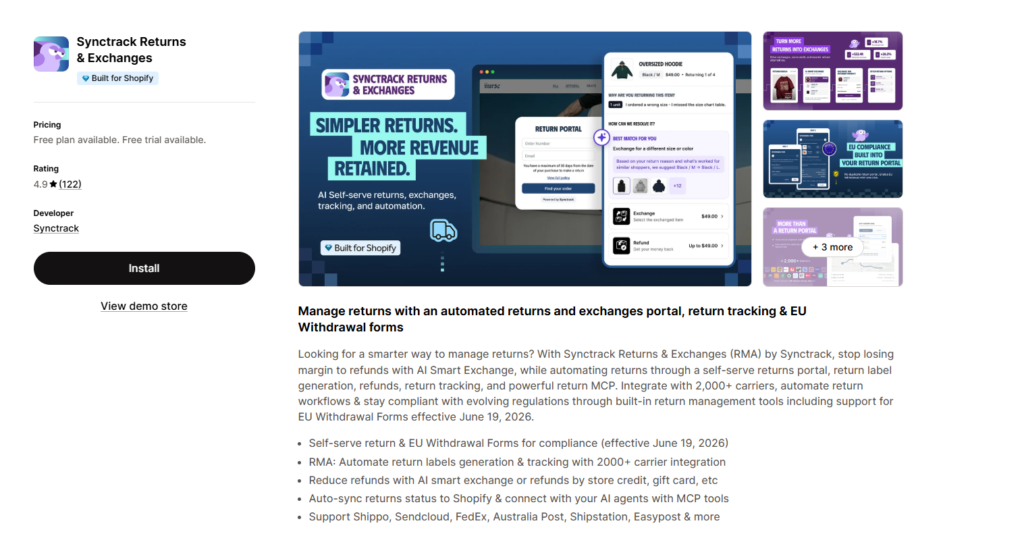
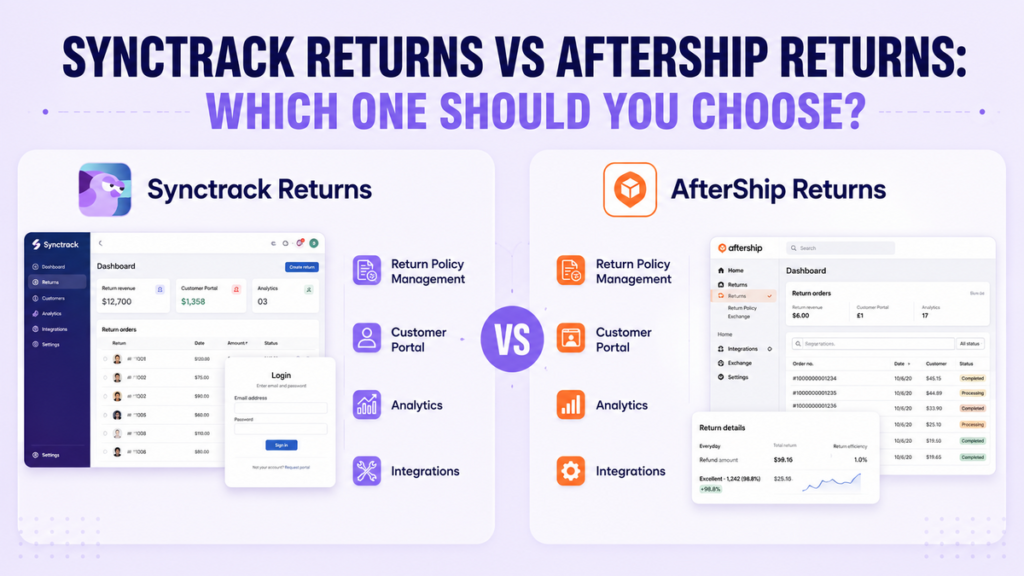
Synctrack Returns is a Shopify-focused app designed to make returns quick and easy to manage. It combines a branded returns portal with automated rules, flexible refunds, and exchanges for variants, products, bundles, and BOGO offers.
Merchants can issue refunds to the original payment method, store credit, gift cards, or discount codes. Customers can also upload videos with return requests, giving merchants more context when reviewing product issues.
Synctrack supports labels through FedEx, Australia Post, Shippo, EasyPost, Shiprocket, and other carriers, with automatic Shopify order updates and tracking. It also offers 24/7 live chat support – even on the free plan – and multilingual portals on paid plans.
With a free plan covering five returns per month and paid plans starting at $19.99/month, Synctrack Returns is a practical option for Shopify stores that want simple setup, predictable pricing, and essential return automation.
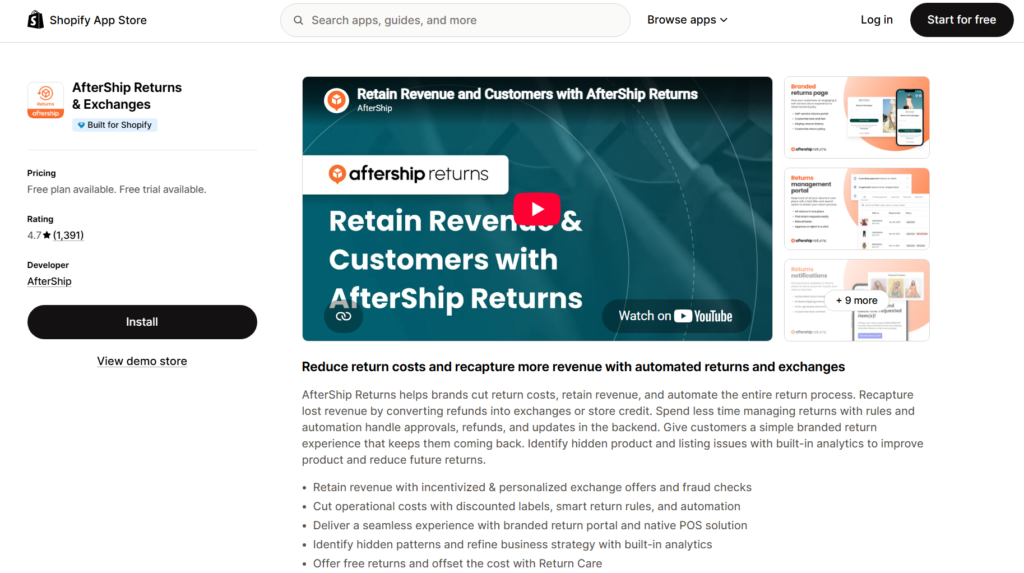
AfterShip Returns is part of AfterShip’s broader post-purchase toolkit, built for merchants who need more advanced control over returns. It offers customizable return portals, automation rules, fraud prevention, exchanges, partial returns, return labels, and return tracking.
It also provides multilingual returns, POS integration, detailed analytics, and integrations with platforms like Shopify, Magento, BigCommerce, Amazon, Gorgias, Zendesk, and Klaviyo. Its API, webhooks, and Enterprise features make it suitable for larger, more complex operations.
The trade-off is that its extensive feature set can mean more setup and a steeper learning curve, especially for smaller Shopify stores.
| Feature | AfterShip Returns | Synctrack Returns |
| Returns portal | Branded self-service page, works for both web and app, supports checkout exchanges | Branded, white-labeled portal on your store |
| Rules and automation | Advanced policy engine with layered, conditional workflows | Unlimited rule-based workflows on premium plans |
| Refunds and exchanges | Original payment, store credit, variant or pickup exchange, partial and bundle returns | Original payment, store credit, gift card, discount code; variant, product, or bundle exchange |
| Shipping labels | QR code drop-off for major carriers | FedEx, Australia Post, Shippo, EasyPost, and more, marketed as 2,000+ integrations |
| Tracking and alerts | Automatic tracking, multi-language email and SMS alerts | Automatic tracking synced to Shopify, built-in email alerts, 24/7 live chat |
| API and integrations | Full REST API and webhooks; connects to Shopify, Magento, BigCommerce, Salesforce | Webhooks on Enterprise plan; Shopify-focused, connects to WMS and ERP on higher tiers |
| Analytics | Dashboard for return rate, reasons, cost, and processing time; CSV export | Basic reporting, with advanced analytics on Premium and up |
| Languages | Fully multilingual portal and emails | Multi-language portal on Pro plans and above |
| In-store returns | Yes, through POS integration | Not available |
| Pricing model | Subscription plus per-return charges above the plan limit | Flat monthly fee per tier |
Both platforms provide a free plan, but they’re designed for different types of merchants. AfterShip’s free Return Care plan uses a revenue-share model for shopper-funded returns , while Synctrack offers 5 free returns. Synctrack’s free plan is more limited in volume, but its paid plans are much more affordable, giving growing Shopify stores a lower-cost path to scale their return management.
| Plan Level | Synctrack | AfterShip |
| Free | $0/month, 5 return requests, unlimited carrier connections and labels, branded return portal, basic refunds and exchanges | Return Care, $0/month, includes Premium features through a shopper-funded returns model, with return labels handled by AfterShip |
| Entry paid | Professional, $19.99/month, 60 requests/month, adds variant exchanges, store credit, gift card refunds, return fees, exchange upsells, and advanced eligibility rules | Essentials, $19/month, 20 returns/month, $0.50 per extra return, with branded returns page, automatic labels, refunds and exchanges, eligibility rules, automatic approval, and analytics |
| Mid-tier | Premium, $49.99/month, 120 requests/month, adds unlimited automation rules, condition-based workflows, automatic return tracking, exchanges for other products, bundle returns, and advanced analytics | Premium, $119/month, 100 returns/month, $1 per extra return, adding advanced workflows, AI-powered exchanges, fraud prevention, warranty management, and pre-built integrations |
| High-tier | Enterprise, $149.99/month, 300 requests/month, multi-store support, WMS integration, API and webhook access, team permissions, custom integrations, and dedicated onboarding | Enterprise, custom pricing for 400+ returns/month, with custom workflows, integrations, API limits, dedicated onboarding and CSM, SLA support, SSO, and unlimited carrier connections |
One of Synctrack’s biggest advantages is its straightforward pricing. Each plan comes with a fixed monthly fee, making costs predictable as you scale. AfterShip combines subscription pricing with usage-based fees, meaning expenses can increase quickly during seasonal spikes or high-return periods.
For Shopify brands looking to control operating costs, Synctrack offers a much lower entry point while still covering the return automation features that most merchants need.
Both apps install quickly from the Shopify App Store, but Synctrack Returns focuses on getting merchants up and running with minimal configuration. Most stores can launch a branded returns portal within minutes thanks to its intuitive interface and Shopify-first design.
AfterShip also offers a smooth initial installation, but unlocking its more advanced workflows often requires additional setup, especially when configuring carrier accounts, automation rules, and external integrations.
Both platforms support branded return portals. However, Synctrack allows merchants to embed the portal directly into their storefront while offering flexible content customization, including its video upload feature for customers to submit visual evidence during return requests-something that helps reduce disputes for products where condition matters.
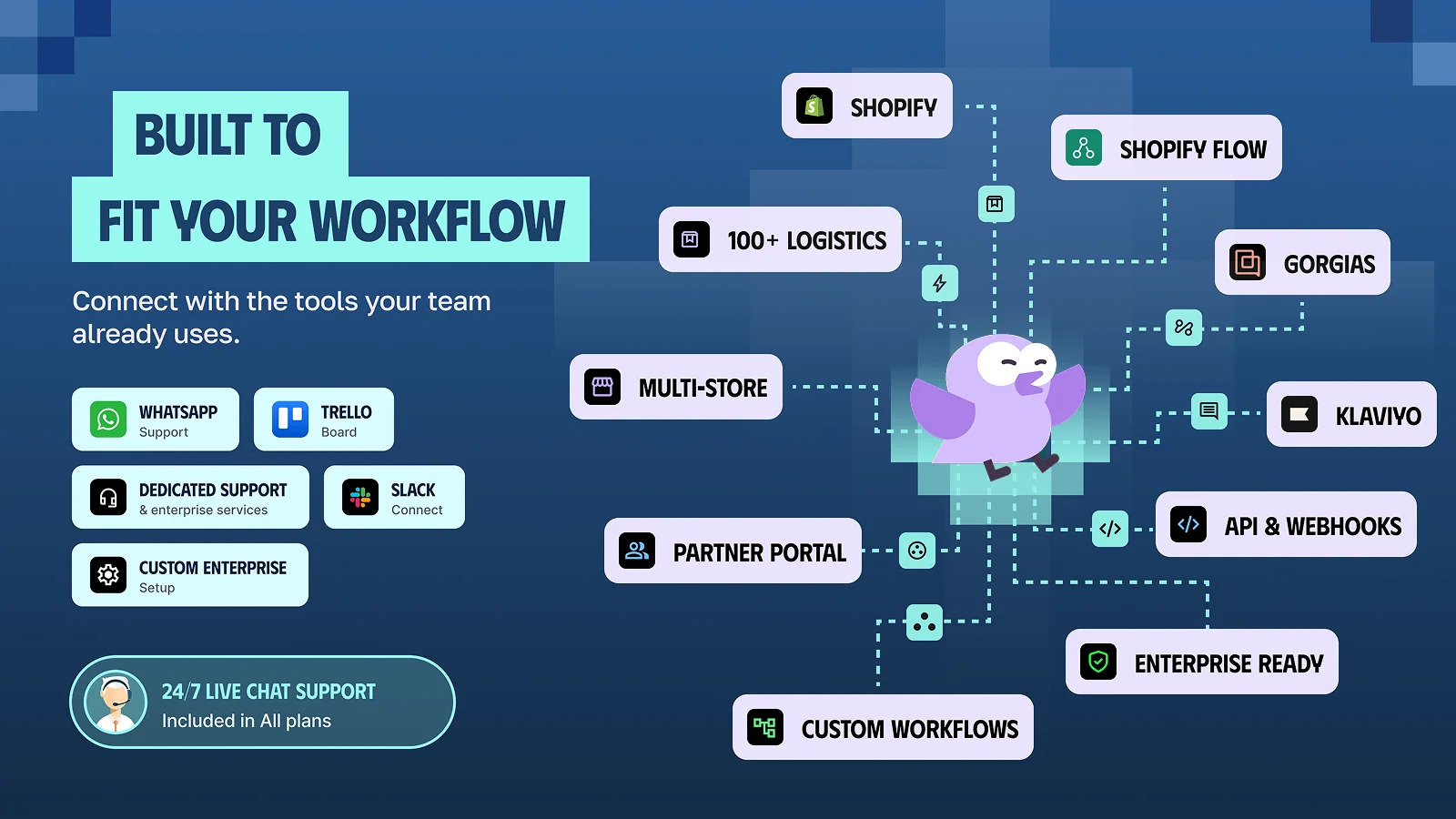
For integrations, the two platforms take different approaches.
AfterShip is built for merchants operating across multiple ecommerce platforms, supporting Shopify, Magento, BigCommerce, Salesforce Commerce, Amazon, and numerous third-party tools.
Synctrack is built primarily for Shopify, while also offering a dedicated app for SHOPLINE merchants. It integrates with shipping platforms like Shippo and EasyPost, supports WMS and ERP connectivity on Enterprise plans, and works with Shopify Flow to automate return workflows. Its Shopify Sidekick integration also lets merchants check return requests, review performance, and manage returns using natural-language commands directly from Shopify Admin.
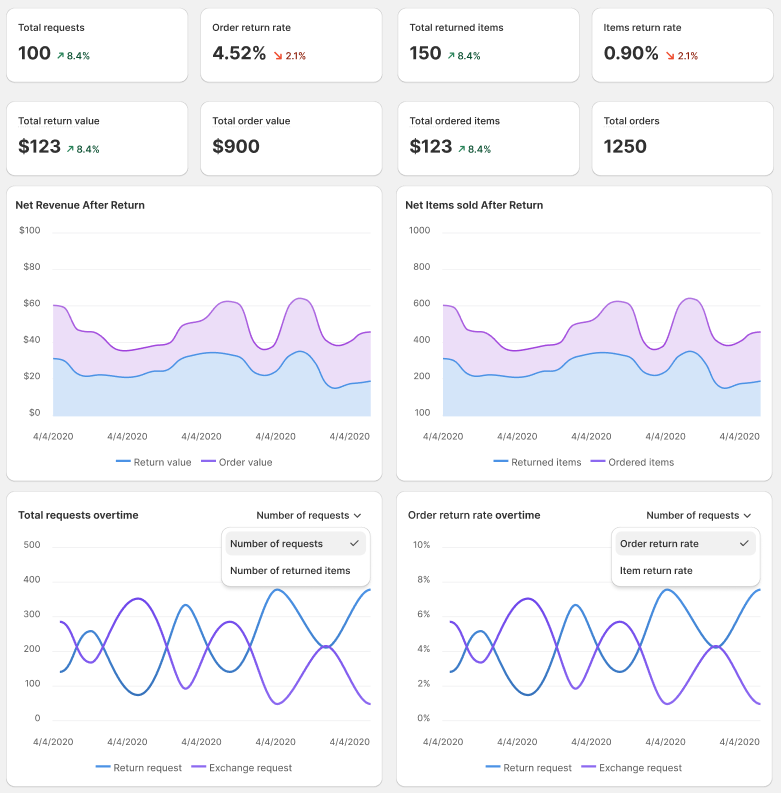
AfterShip provides a comprehensive analytics dashboard with detailed reporting on return reasons, processing times, shipping costs, and return rates.
Synctrack delivers the essential reporting most Shopify merchants need, while advanced analytics become available on Premium plans. For many small and mid-sized businesses, this keeps the interface cleaner and easier to navigate without sacrificing important operational insights.
Customer support is an area where Synctrack stands out.
Synctrack provides 24/7 live chat support across all plans, including its free tier, alongside dedicated onboarding assistance for Enterprise customers. Merchant reviews consistently highlight the team’s responsiveness and willingness to resolve issues quickly.
AfterShip offers standard support, with dedicated customer success resources reserved for Enterprise merchants. While many merchants have positive experiences, reviews occasionally mention slower response times on lower-tier plans.
Both platforms support multiple languages for return portals and customer communications, making them suitable for international sellers. Both platforms support multiple languages for return portals and customer communications, helping international merchants provide a more localized return experience. Synctrack also allows merchants to customize portal content and messaging for different markets, making it easier to maintain a consistent brand experience across regions.
Both AfterShip Returns vs Synctrack Returns are capable Shopify returns management solutions, but they cater to different merchant priorities.
AfterShip Returns is geared toward larger businesses that need enterprise-grade workflows, extensive carrier coverage, and multi-platform compatibility. However, those advanced capabilities come with a steeper learning curve and pricing that can increase as return volume grows.
Synctrack Returns, on the other hand, focuses on delivering a streamlined Shopify experience with predictable pricing, fast implementation, and responsive customer support. While it doesn’t offer every enterprise feature available in AfterShip, it provides the core functionality that most Shopify merchants need, making it an attractive option for small to mid-sized businesses looking for an easy-to-manage returns solution.
| AfterShip Returns | Synctrack Returns | |
| Pros | • Comprehensive feature set with advanced automation, warehouse integrations, and detailed analytics.
• Extensive carrier network with approximately 310,000 drop-off locations. • Supports multiple ecommerce platforms beyond Shopify, including Magento and BigCommerce. |
• Transparent flat-rate pricing with predictable monthly costs.
• Broad carrier coverage through trusted logistics partners like Shippo and EasyPost. • Quick setup with an intuitive Shopify-first interface. • 24/7 live chat support available across all plans, including the free tier. • Includes a unique video upload feature for return requests. |
| Cons | • Costs can increase significantly as return volume grows due to per-return charges.
• Advanced features require more setup and configuration, resulting in a steeper learning curve. • Customer support experiences vary, with some merchants reporting slower response times on lower-tier plans. |
• Free plan is limited to five returns per month.
• Lacks some enterprise-focused capabilities, such as native in-store POS returns. • Has fewer public reviews because it is a newer solution in the Shopify ecosystem. |
The right pick depends on your order volume, your tech stack, and your budget more than anything else.
To put it simply: Synctrack works well for stores that want a fast setup, predictable pricing, and responsive support. AfterShip works well for stores that want deeper automation, broader integrations, and detailed reporting. Both are solid, well-built options – the better fit comes down to your store’s size and how you like to work.
In the end, Synctrack Returns vs Aftership Returns comes down to what works best for your store. Before you choose, look at your current return volume, your tech stack, and how much time you want to spend managing rules and reports. That’s usually enough to point you toward the right fit.