An international customer reaches checkout but cannot use a familiar currency or payment method. That friction may be enough to lose the sale. The Airwallex payment gateway addresses this problem with online payment acceptance, local methods, multi-currency settlement, payment links, ecommerce plugins, and APIs. This guide explains what Airwallex is, how it works, what it costs, when funds become available, and whether Airwallex is legit.
| Area | What Airwallex offers |
| Payment acceptance | Cards, digital wallets, bank-based methods, buy now, pay later options, and other local methods, subject to availability |
| Geographic reach | Airwallex advertises payment acceptance from customers in 180+ countries |
| Currencies | Pricing or collection in 130+ currencies, depending on the payment method and setup |
| Integration choices | Hosted checkout, embedded components, native APIs, mobile SDKs, ecommerce plugins, payment links, and invoices |
| Ecommerce platforms | Plugins for Shopify, WooCommerce, Magento, BigCommerce, and other supported platforms |
| Settlement | Funds can settle to an Airwallex Wallet, including like-for-like settlement in supported currencies |
| Post-payment tools | Captures, refunds, reporting, reconciliation, fraud controls, and dispute management |
| Best fit | Ecommerce, SaaS, marketplaces, platforms, and other businesses collecting payments across borders |
Availability is tied to the country where the business is registered, the Airwallex entity serving the account, the selected payment method, and the integration used. The advertised global totals do not mean every merchant can activate every method or currency.
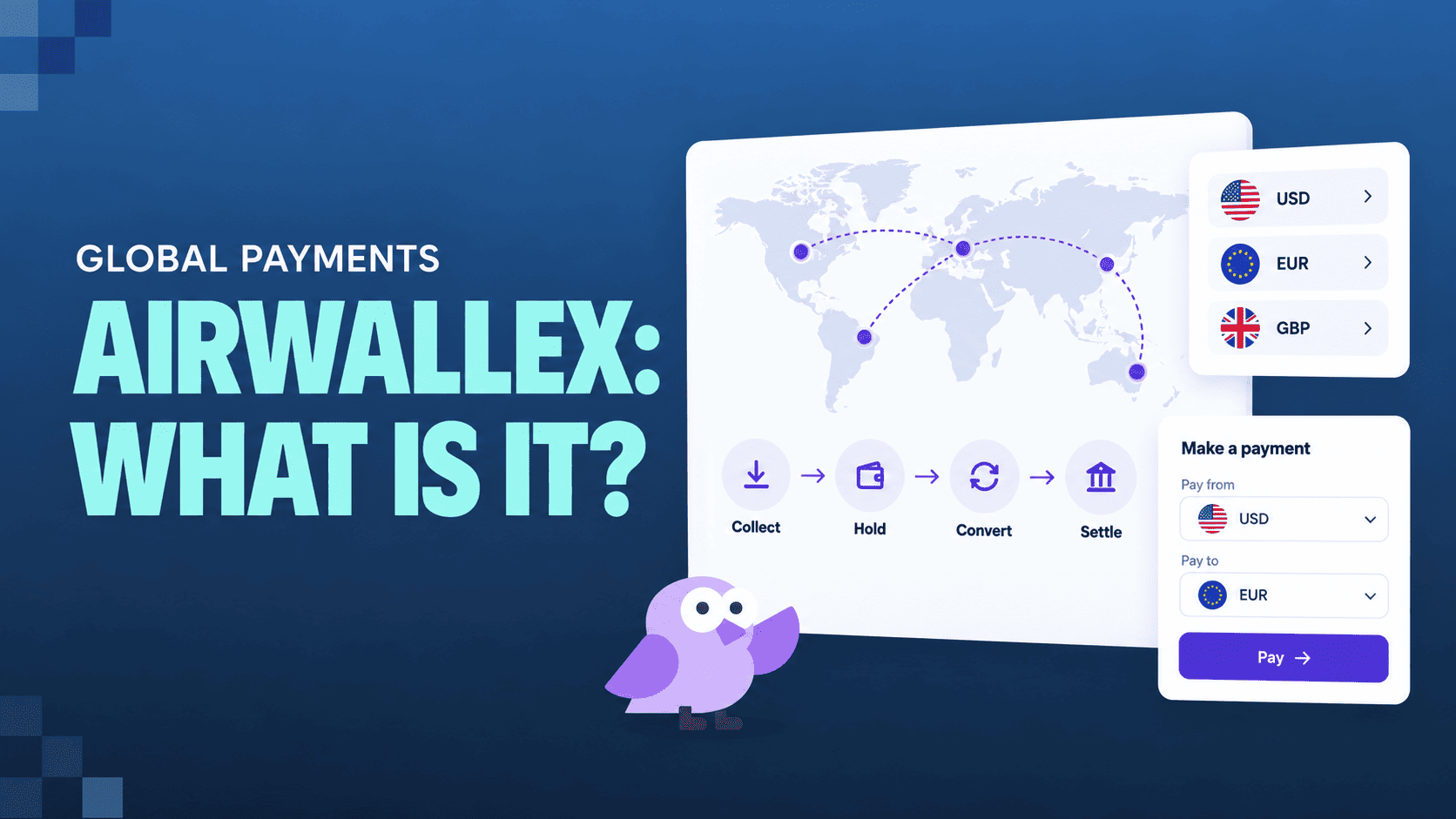
Airwallex is a global financial technology platform for businesses. Its wider product suite includes business accounts, foreign exchange, international transfers, corporate cards, expense management, billing, and online payment acceptance.
Airwallex Payments lets businesses collect customer payments through gateway technology, processing functions, checkout tools, and settlement into an Airwallex Wallet. A traditional gateway may only pass payment data to a processor; Airwallex can connect acceptance with its multi-currency financial infrastructure.
It offers both gateway and payment processing capabilities.
The gateway is the secure technical layer that carries the payment request from the checkout to the relevant payment network or provider. Processing covers the steps required to authorize, capture, and settle that transaction. Depending on the market and method, Airwallex can also provide acquiring, risk controls, and settlement services.
Merchants can accept a payment, receive proceeds in an Airwallex Wallet, hold eligible currencies, convert funds, or use them for supported payouts and spending.
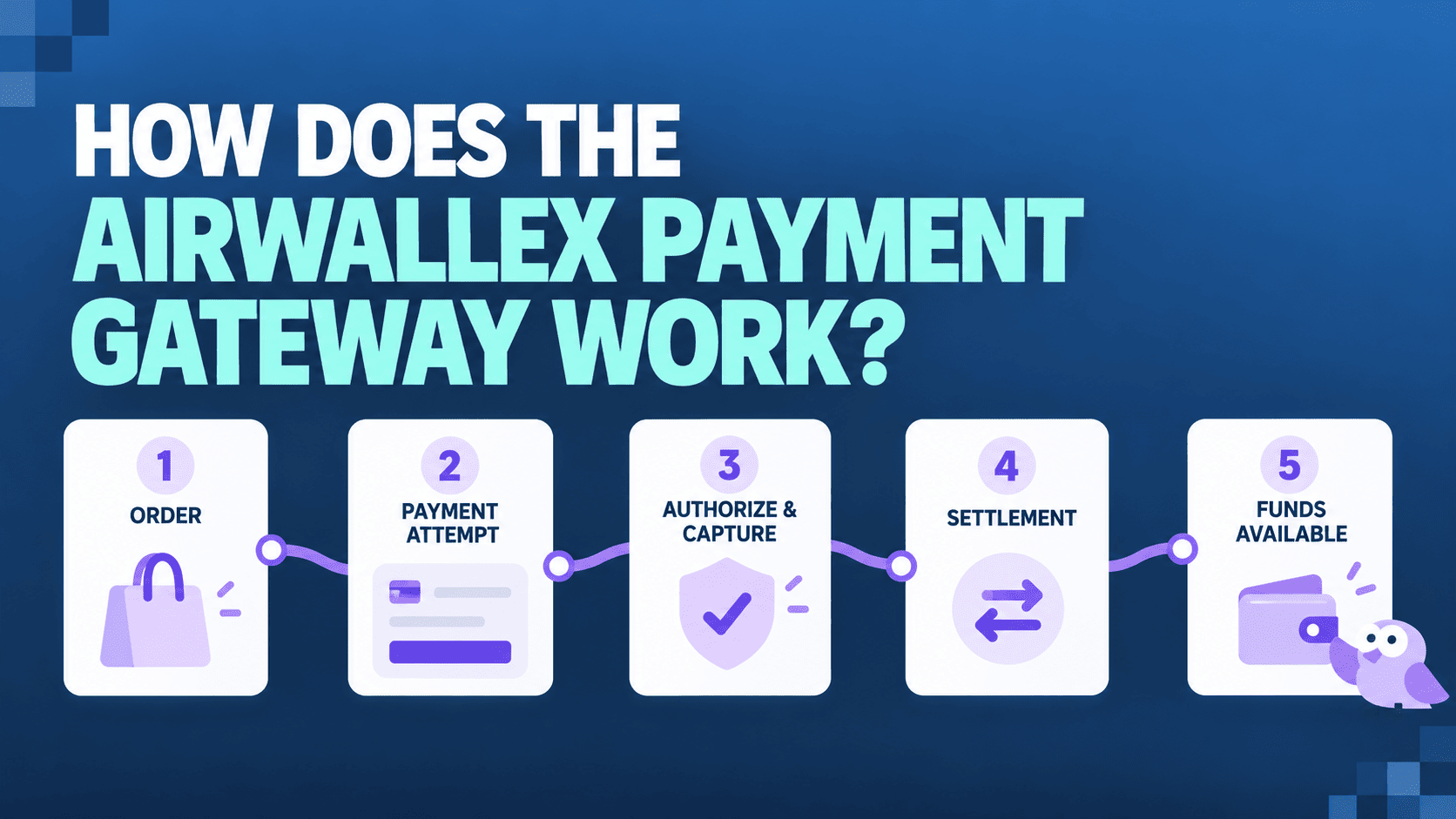
The exact route changes by integration and payment method, but the basic Airwallex payment flow has five stages.
The shopper reaches checkout through a website, app, invoice, or payment link. Airwallex creates a PaymentIntent that follows the transaction through payment attempts, refunds, and disputes.
When the customer submits a card, wallet, or local method, Airwallex creates a linked PaymentAttempt. If it fails, the intent may remain open so the shopper can try again.
Airwallex routes the request through the relevant network, and the customer’s bank or provider approves or declines it. Capture may happen immediately or later, depending on the method and merchant configuration.
A successful capture does not make the money immediately available. The method must clear before Airwallex includes the proceeds in a settlement batch. Settlement is shown as T+N: “T” is the capture date, and “N” is the applicable number of days. Most card and direct debit schedules use business days, while some local methods use calendar days.
The merchant’s reserve plan can extend the wait. If a seven-day rolling reserve applies, Airwallex releases funds according to the longer of the payment method’s settlement period and the reserve period.
After settlement and any reserve period, funds appear in the available balance. Merchants should therefore track payment success, settlement, and availability as separate events.
Airwallex offers integration paths ranging from no-code collection to a fully custom checkout.
Airwallex documents plugins for Shopify, WooCommerce, Magento, BigCommerce, SHOPLINE, and other platforms. They reduce development work but give merchants less checkout control than a custom integration.
A hosted page redirects the shopper to an Airwallex-controlled checkout. It offers a faster launch and lower PCI scope, but the team should test the off-site transition on mobile and desktop.
A drop-in element adds a prebuilt multi-method checkout to the merchant’s page. Individual elements offer more layout control but require more integration and testing.
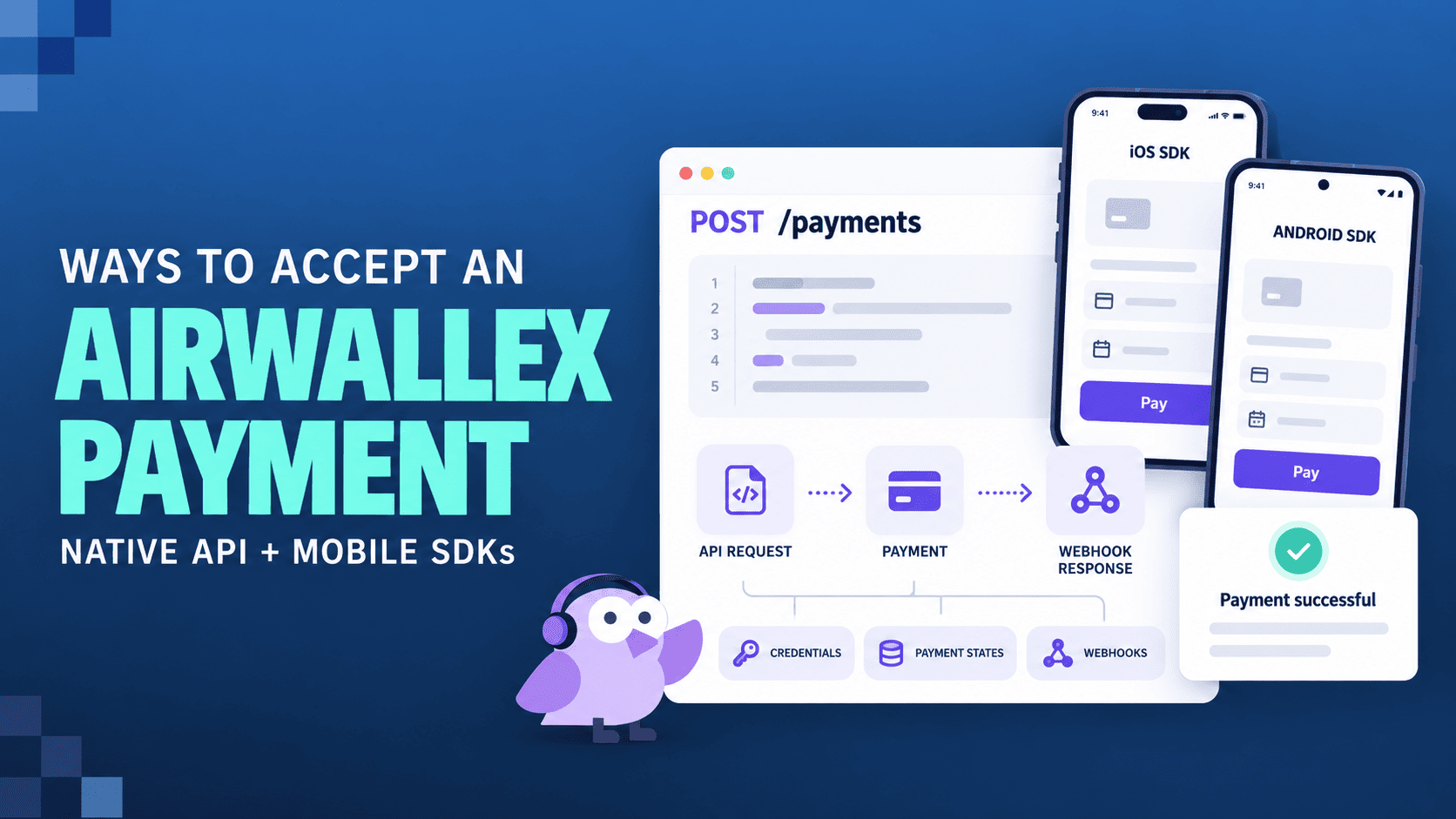
APIs and SDKs support custom flows for SaaS products, marketplaces, platforms, and mobile apps. The team must manage checkout code, payment states, credentials, webhooks, and post-payment operations.
Payment Links create a hosted page that can be shared through email, social media, chat, an invoice, or a QR code. They suit remote and one-off sales but do not replace an ecommerce storefront.
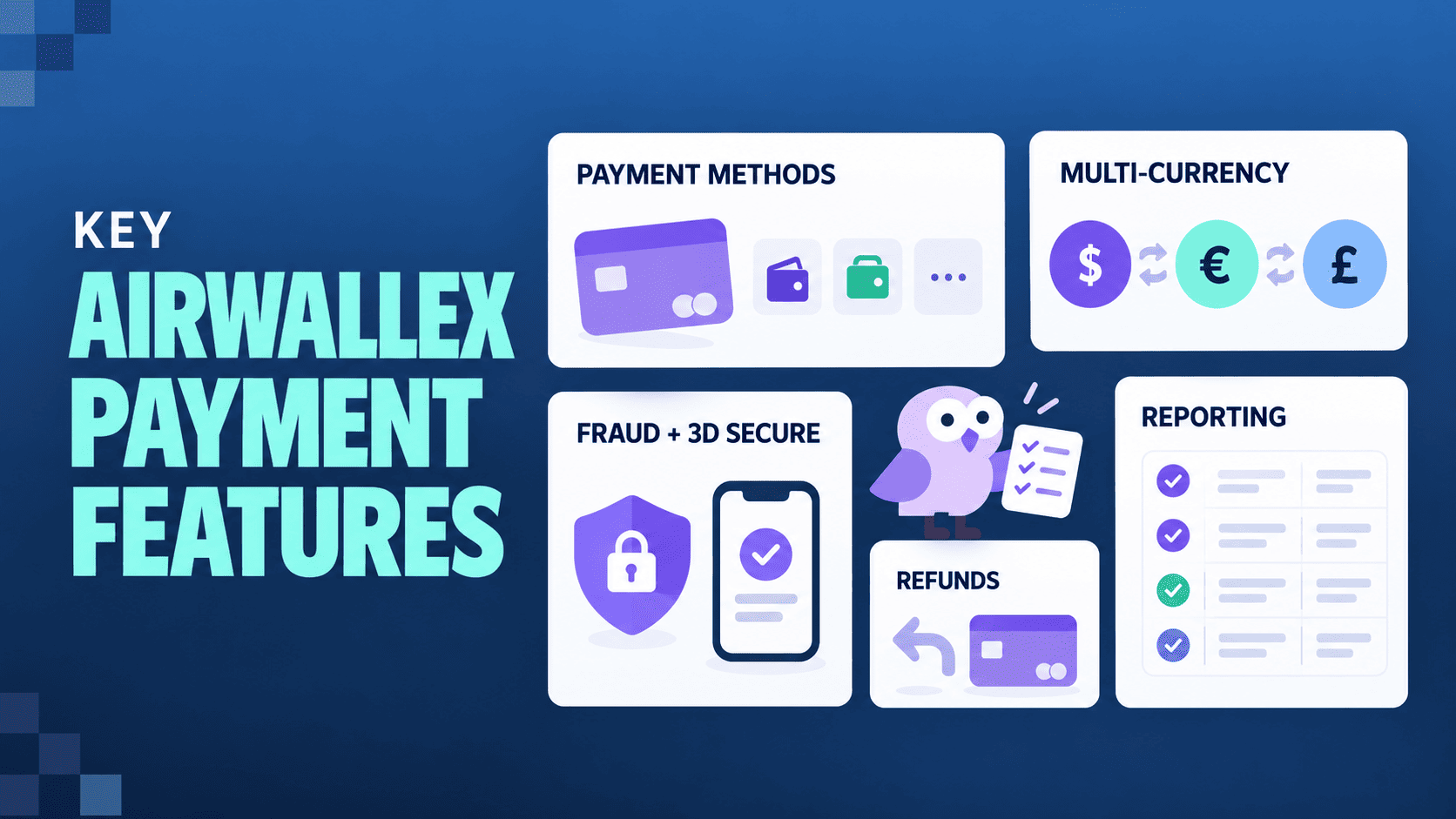
Airwallex advertises support for major card schemes and more than 160 global and local payment methods. The wider list includes cards, digital wallets, bank-based methods, and buy now, pay later options.
Coverage depends on merchant location, shopper location, currency, and integration. Before promising a method, confirm all four along with its settlement, refund, and dispute support.
International sales can create repeated currency conversion. Airwallex supports like-for-like settlement for eligible currencies. A USD payment can settle to a USD balance when USD is configured as a principal settlement currency, reducing avoidable conversion but not processing or payment-method fees.
Payments in currencies outside the principal settlement list are converted into the fallback settlement currency. Merchants should configure their Wallet balances before going live so they do not trigger avoidable conversions.
Airwallex provides an integrated fraud engine and 3D Secure tools. Its risk controls can assess transactions and determine when authentication is appropriate, subject to configuration and local requirements.
These tools can reduce fraud exposure, but merchants still need clear billing descriptors, accurate product information, accessible support, and proof of fulfillment.
Airwallex supports full and partial refunds when the payment succeeded, the method permits refunds, the time limit remains open, no active dispute blocks the action, and enough refundable funds are available.
For Shopify orders, Airwallex instructs merchants to initiate refunds from Shopify. Refunding only in the Airwallex web app may leave the Shopify order status out of sync.
Payment, settlement, fee, and transaction reports connect the original sale with fees, conversion, refunds, chargebacks, and the net amount reaching the Wallet.
There is no single global Airwallex fee. Pricing changes with the merchant’s country, account plan, card origin, payment method, currency flow, and commercial agreement.
Airwallex documents two common pricing approaches:
The full cost may include a gateway fee, payment-method fee, currency or multi-currency pricing charges, dispute fees, fraud services, and the monthly price of the selected account plan.
The table below shows public card rates displayed on Airwallex pricing pages on October 24, 2026. These are examples of regional variation, not universal quotes.
| Merchant market | Domestic cards | Other published card rates |
| United Kingdom | 1.30% + £0.20 | EEA: 2.40% + £0.20; international: 3.15% + £0.20 |
| United States | 2.80% + $0.30 | International: 4.30% + $0.30 |
| Australia | 1.65% + A$0.30 | International: 3.45% + A$0.30 |
Local methods have their own fees. Airwallex’s current regional pages commonly show a fixed gateway amount plus the payment-method fee rather than one rate for all local methods.
To estimate the real cost, model your own transaction mix:
Shopify merchants should also check whether Shopify applies a third-party transaction fee for their plan and country. That platform fee, where applicable, is separate from Airwallex processing charges.
Airwallex does not publish one payout time that applies to every transaction. Availability depends on:
A payment captured after the daily cut-off may be treated as captured on the following day. Weekends can also extend a business-day schedule.
The most reliable answer is inside the account. Merchants can review settlement timing and the active reserve plan under Payments settings. This is more useful than relying on a general statement such as “instant settlement,” even when a particular method supports T+0.
Airwallex provides Shopify payment apps for supported merchant locations. Its documentation currently lists merchants in Australia, Canada, Switzerland, the European Economic Area, Hong Kong, Israel, Japan, Malaysia, Mexico, New Zealand, Singapore, the UK, and the US.
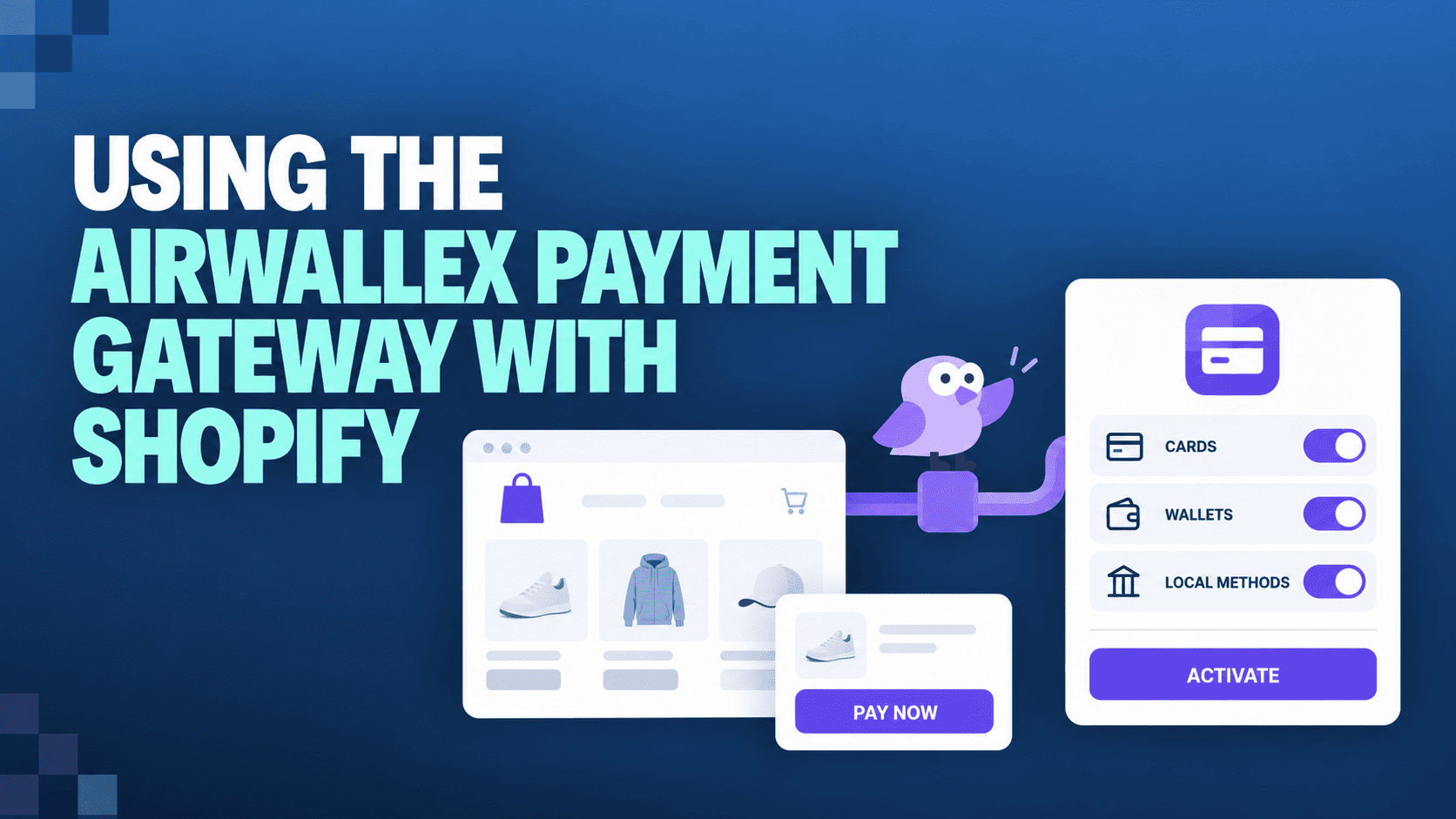
The Shopify integration can support card payments, wallets, local methods, refunds, partial refunds, 3D Secure, and manual or automatic capture, depending on the installed Airwallex app and payment method.
Before installing it, check four practical points:
Airwallex also requires payment activation. The business may need to submit company, ownership, website, and product information. Some accounts receive a reserve plan based on factors such as industry, payment activity, dispute rate, refund rate, and financial stability.
Yes. Airwallex is an established financial technology company operating through licensed or registered entities in multiple markets. That status does not replace a business risk assessment.
Examples of its regulatory status include:
Airwallex publishes PCI DSS Level 1 certification information and states that it is SOC 2 compliant.
The legal structure differs by country. In the UK, Airwallex is an electronic money institution rather than a bank. Businesses should check the entity in their agreement and the local protection that applies to their money.
Airwallex is a regulated, operating platform. Its suitability still depends on the local entity, contract, service needs, and tolerance for account and reserve controls.
| Potential advantages | Points to check |
| Broad international and local payment coverage | Coverage varies by merchant country, shopper country, currency, and integration |
| Like-for-like settlement in supported currencies | Unsupported currencies may convert into the fallback currency |
| No-code, low-code, plugin, and API options | More customization requires more technical and compliance work |
| Payment acceptance connects to a multi-currency Wallet | Settlement and reserve rules can delay availability |
| Shopify and other ecommerce integrations | Shopify may add a third-party transaction fee in some setups |
| Built-in reporting, fraud, refund, and dispute tools | Pricing includes several possible components and is market-specific |
| Regulated entities in multiple jurisdictions | It is not a bank in every market, and protections differ by entity |
Airwallex is most compelling when cross-border collection and multi-currency operations are real business needs. A domestic merchant accepting one currency may not benefit enough from the wider platform to justify the setup and pricing structure.
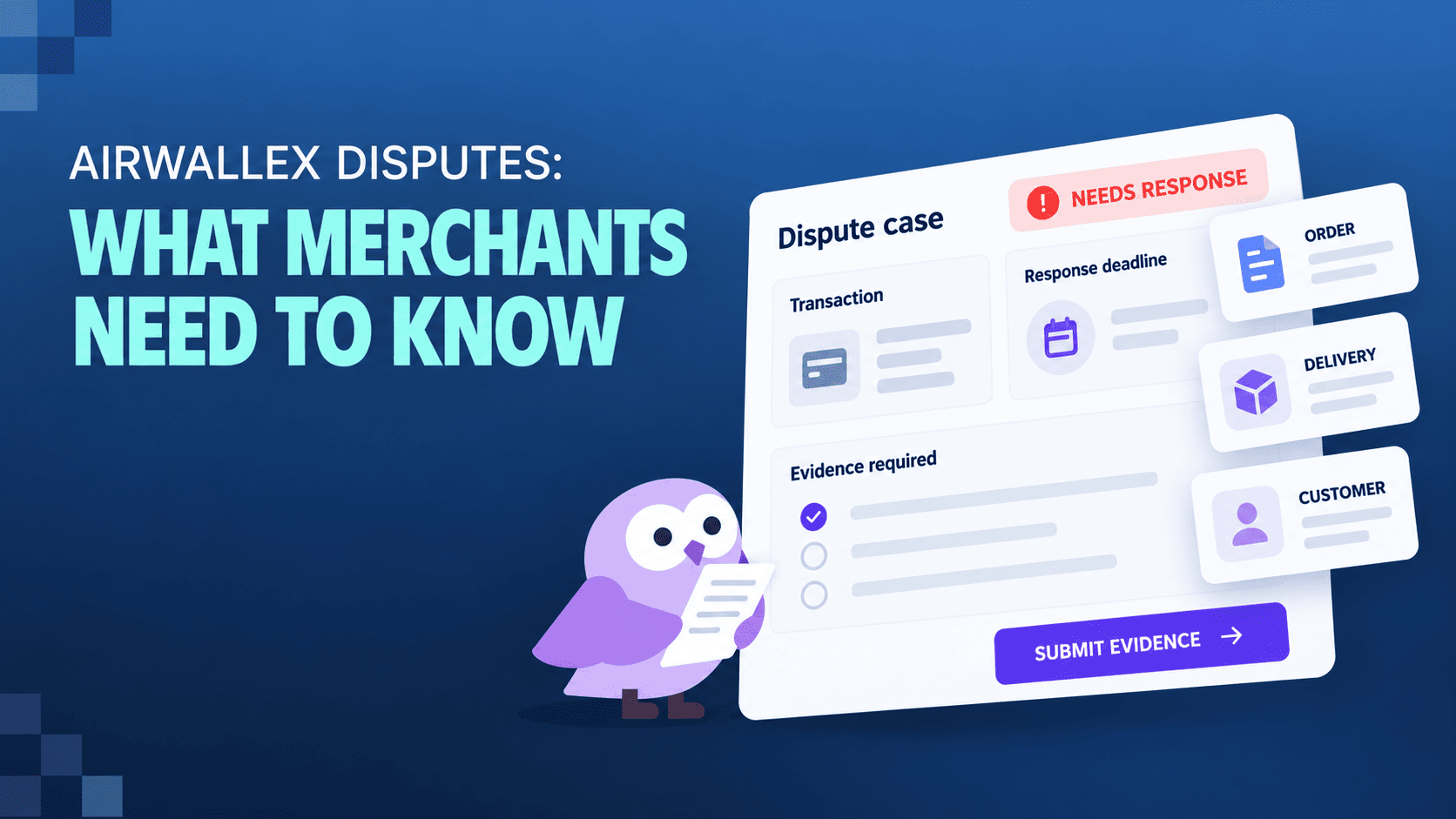
A dispute begins when a shopper challenges a payment through the issuing bank or another payment provider. Airwallex sends notifications by email and webhook, shows the reason and status in its web app, and exposes dispute information through its API.
The response path depends on the payment method and dispute stage. Airwallex documentation describes request-for-information, pre-chargeback, chargeback, and later escalation stages. Some requests allow 15 days to act, while certain pre-chargeback programs use a 65-hour window. Local methods can follow different rules.
Always use the deadline displayed on the case. Missing it can result in automatic acceptance or escalation.
Useful evidence depends on the claim. A physical-goods case may need the order description, shipping address, carrier, tracking number, shipment date, and delivery confirmation. A digital product may require access logs. A refund case may need the refund date, amount, and Acquirer Reference Number. Policies are useful when they were clearly presented and relevant to the reason code.
The goal is to answer the specific claim with concise, consistent records. Sending a large collection of unrelated screenshots does not make the response stronger.
For Shopify merchants, Airwallex cases, Shopify order details, carrier proof, and supporting files often sit in separate systems. Every handoff adds time and creates another chance to miss information.
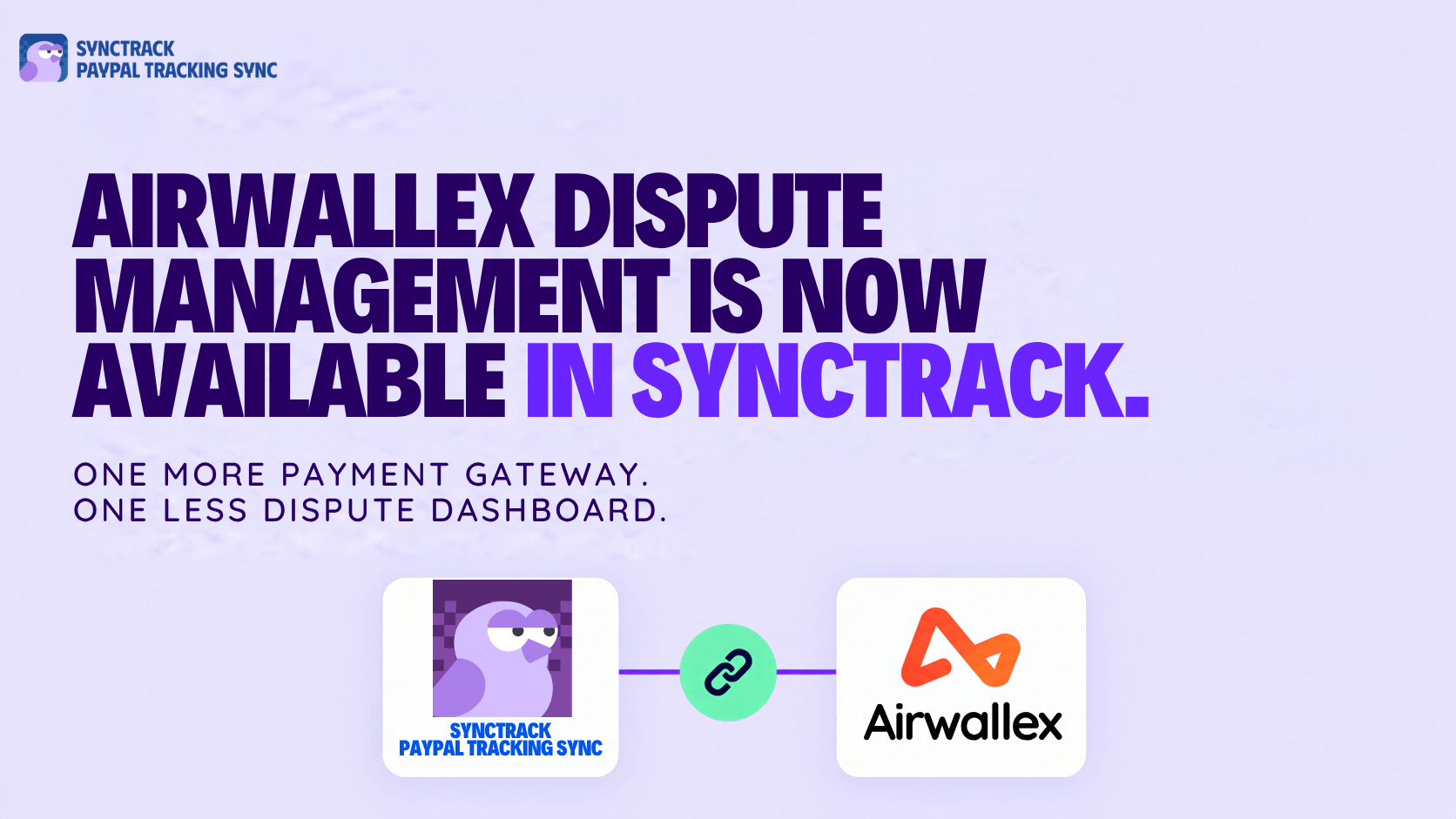
Synctrack Paypal Chargebacks brings Airwallex dispute management into the same workspace as the Shopify order and fulfillment context. Once connected, merchants can:
By default, Synctrack checks Airwallex for updates every 10 minutes. Merchants can add an optional webhook for near-real-time status updates.
Synctrack only needs a restricted API key with permission to read payment data, manage disputes, and upload files. The setup guide recommends leaving all other permissions off, and Synctrack never moves funds.
Connecting Airwallex is available on all Synctrack plans, including Free. Responding to imported disputes requires Basic or higher. Merchants should check the current product page and plan terms before relying on a specific capability.
Synctrack does not decide the dispute or guarantee a win. Its value is operational: it puts the deadline, Shopify order, tracking context, and evidence workflow together so the merchant can prepare a relevant response without repeatedly switching systems.
>>> See how Airwallex dispute management works in Synctrack.
Airwallex may fit businesses selling across markets, offering local methods, holding several settlement currencies, or connecting acceptance to international financial operations.
Before committing, answer these questions with your own data:
The answers make the decision clearer than a headline transaction rate. For the right international merchant, Airwallex can reduce the number of separate payment and currency tools the team manages. For a simple domestic operation, it may provide more infrastructure than the business needs.
An Airwallex payment is a transaction accepted through Airwallex Payments using an eligible card, wallet, bank-based option, buy now, pay later service, or local method.
Yes. Its gateway sits within a broader platform offering processing, checkout tools, plugins, links, settlement, and post-payment operations.
Airwallex operates through regulated or registered entities and publishes PCI DSS Level 1 certification information. Verify the entity, account terms, controls, and safeguarding rules that apply locally.
Not in every market. Its UK entity, for example, is an electronic money institution. Status and fund protection vary by jurisdiction.
Costs vary by country, card origin, method, currency flow, pricing model, plan, and agreement. Calculate them using the local price list and actual payment mix.
It follows the method’s T+N schedule and the account’s reserve plan. Cut-off times, weekends, currency setup, and reviews can affect availability.
Yes, in supported countries and for eligible methods. Confirm merchant eligibility, method coverage, fees, and refund workflow before launch.
Yes, subject to payment status, method rules, time limits, active disputes, and available refundable funds. Shopify merchants should start the refund in Shopify.
Airwallex shows the case in its web app or API. The merchant may accept or challenge it, depending on the method and stage. Always follow the case deadline.
Yes. Synctrack offers this workflow, linking cases with Shopify orders and tracking context. Connection is available across plans; responses require Basic or higher.
The Airwallex payment gateway is designed for businesses that need more than basic card acceptance. Its value comes from combining global and local payment methods, flexible checkout options, multi-currency settlement, and wider financial operations. Those benefits are strongest when a merchant genuinely sells across borders.
The decision still requires careful checking. Fees, available methods, settlement timing, reserves, and customer-fund protections vary by market and account. Shopify merchants should also plan for the work that continues after checkout, especially refunds, reconciliation, and disputes. When an Airwallex case opens, Synctrack can bring the deadline, order, tracking data, and evidence workflow into one place, helping the team respond with less manual work.
Sources