Returns are part of running an online store. You can’t avoid them, but you can control their cost and turn more returns into repeat sales. Synctrack Returns vs Swap Returns comes down to who each platform is built for.
Synctrack is a Shopify-focused app designed for small and mid-sized stores, while Swap Returns by Swap Commerce targets larger, global retailers with complex shipping and warehouse needs. Below, we’ll compare their features, pricing, and key differences to help you find the right fit.
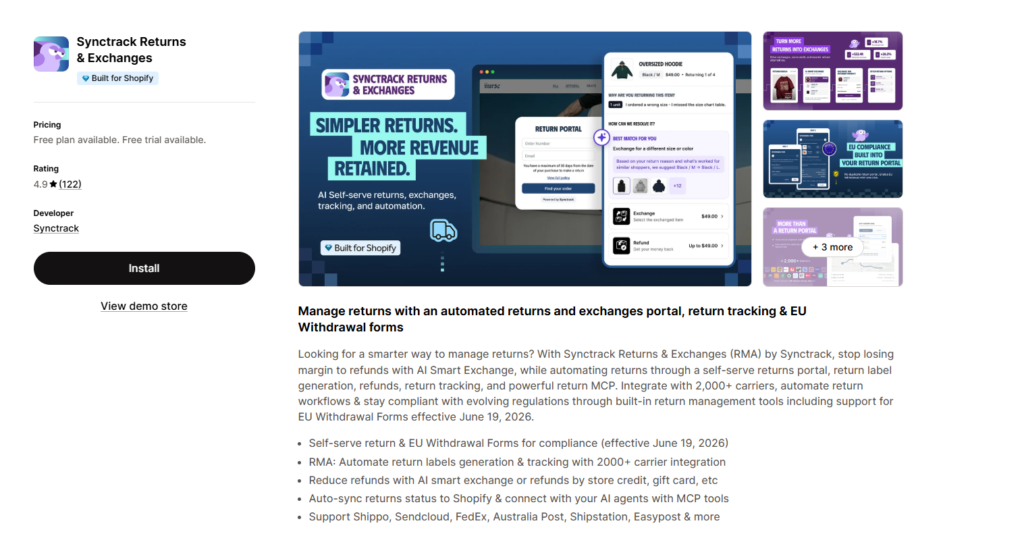
Synctrack Returns & Exchanges lives inside Shopify. It gives your customers a branded portal where they can start a return or exchange on their own, without emailing your support team first. Behind the scenes, it prints shipping labels, applies your return rules automatically, and keeps everything synced with your Shopify order data. Synctrack says it’s used by more than 3,000 retailers and connects to over 2,000 shipping carriers through partners like Shippo and EasyPost.
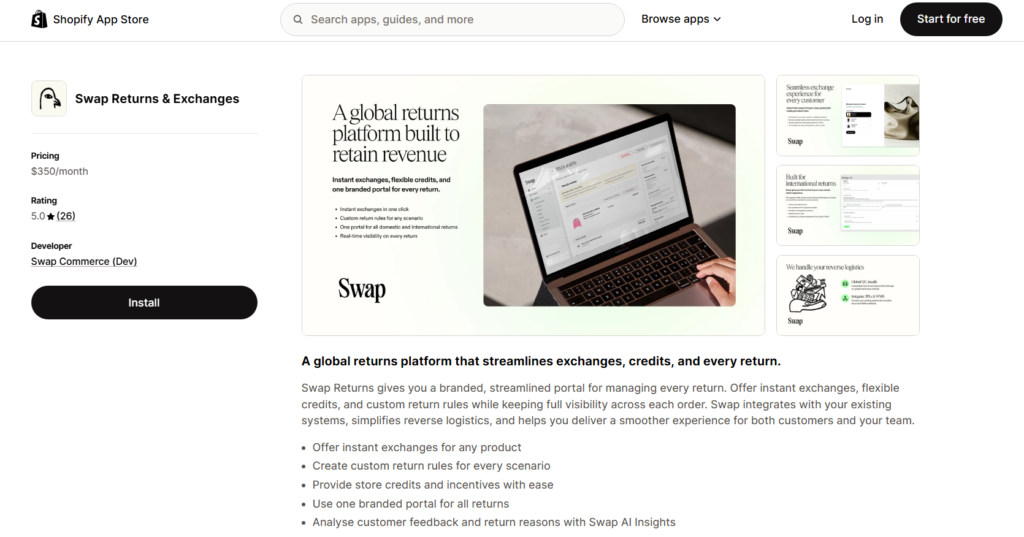
Swap Returns is one product inside a larger suite from Swap Commerce, which also covers shipping and buyer protection. Swap’s returns tool is built for global brands running stores across several countries. It gives every shopper the same branded portal no matter where they’re buying from, and it connects to warehouses and outside logistics providers so a return isn’t just logged- it’s actually routed, checked, and restocked automatically. Swap also leans heavily into what it calls “exchange-first” returns, meaning the whole flow is designed to nudge customers toward a swap or store credit instead of a straight refund.
Both platforms are chasing the same goal: fewer flat refunds and more money staying in your store. They just aim at very different sizes of business to get there.
EU compliance is one area where Synctrack has a clearer built-in advantage. From June 19, 2026, updated EU consumer rules require eligible distance contracts made through an online interface to provide an easy-to-find online withdrawal function.
Synctrack includes a dedicated EU Withdrawal Form inside its returns system. Once enabled, the withdrawal rules apply automatically to EU orders, giving eligible customers a way to submit a withdrawal request through the store’s return flow. Synctrack lists this feature specifically as support for the EU requirements effective June 19, 2026.
Swap also supports returns for European and international merchants, but its current Shopify listing does not identify a dedicated EU Withdrawal Form or withdrawal-button workflow. That doesn’t mean a merchant using Swap cannot meet EU requirements, but they may need to confirm how the required withdrawal function is handled in their setup.
For merchants selling to EU consumers, this makes Synctrack’s built-in withdrawal workflow a meaningful difference: the compliance-related feature is already part of the returns platform rather than something the merchant needs to validate separately.
Synctrack and Swap tackle returns differently. For most single-store, Shopify-based businesses, Synctrack covers more ground; Swap’s advantages only pay off once you have real cross-border warehouse complexity to manage. Keep this comparison table in mind – we’ll break down each difference in detail below.
| Category | Synctrack | Swap |
| Portal branding | Auto-syncs Shopify colors, logo, policy; embeds in storefront and account page | Branding set up manually; no storefront embed |
| Custom domain | Yes | Yes |
| Return reasons + photo proof | Yes | Yes |
| Video evidence | Yes | No |
| Exchanges (size/color, different product) | Yes | Yes |
| Exchange incentive | Bonus credit + retain pop-up | “Shop Now” bonus (no retain pop-up) |
| Reserve stock during exchange | Yes | Yes |
| Pre-order exchanges | Yes | Limited |
| Refund to original payment | Yes | Yes |
| Store credit / gift card | Yes | Yes |
| Discount code refund | Yes | No |
| Bank transfer refund | Yes | No |
| BOGO/bundle partial refund | Yes, calculated correctly | No |
| Return window / rule automation | Yes | Yes |
| Auto-approve / auto-label | Yes | Yes |
| Return, restocking, handling fees | Yes | Yes |
| Prepaid labels, packing slips, QR returns | Yes | Yes |
| Carrier coverage | 2,000+ carriers, auto-picks cheapest/fastest | Major carriers + Happy Returns; no auto-select |
| Return tracking page/auto inbound tracking | Yes | No |
| Warehouse / 3PL routing | Basic | Deep- connects to Mintsoft, Peoplevox, etc. |
| Shopify 2-way sync | Yes | Yes |
| Gorgias integration | Yes | Yes |
| Shopify Flow | Yes | No |
| AI assistant (MCP) support | Yes | No |
| Open API / webhooks (WMS, ERP) | Yes | Yes (e.g., Brightpearl) |
| Works outside Shopify | No (Shopify + Shopline only) | Yes |
| Multi-store management | Yes (extra cost after 2 stores) | No |
| Partner portal | Yes | No |
| Support channels | Live chat 24/7; WhatsApp/Trello/Slack on higher plans | Live chat 24/7; email/ticket |
| Role-based permissions | Yes | Yes |
Both platforms let you put your own branding on the portal, including a custom domain, so customers never feel like they’ve left your site. Synctrack takes this further by pulling in your Shopify colors, logo, and return policy automatically- there’s no manual setup involved. It can also embed the portal directly into your storefront and onto the customer account page, so returns feel like a normal part of shopping with you.
Swap’s portal covers multiple regions and languages well, which matters for a global brand. But branding has to be set up by hand, and it doesn’t embed into the Shopify storefront the way Synctrack’s does.
Both apps let you collect specific return reasons and ask for photo proof of an item’s condition, which helps you spot patterns and catch fraud. Synctrack goes one step further and accepts video evidence too, which is useful for damage claims or when a photo alone doesn’t tell the full story.
Note: Swap doesn’t currently support video uploads.
This is where both platforms work hardest, because a successful exchange keeps money in your store instead of sending it back out the door.
Both tools let customers swap for a different size or color, or trade for a completely different product. Synctrack adds a “retain” pop-up that tries to win back the sale before a customer confirms a refund, along with bonus credit to make an exchange more appealing and the option to exchange for pre-order items. Swap offers something similar, called a “Shop Now” bonus, and lets customers reserve inventory during an exchange so it doesn’t sell out while their return is in transit. Swap doesn’t have a retain pop-up, though, and its support for pre-order exchanges is limited.
Synctrack gives customers several ways to get their money back: the original payment method, store credit, a gift card, a discount code, or a direct bank transfer for orders that were paid outside Shopify checkout. It also calculates partial refunds correctly for BOGO deals and bundles, which is a detail a lot of return apps get wrong.
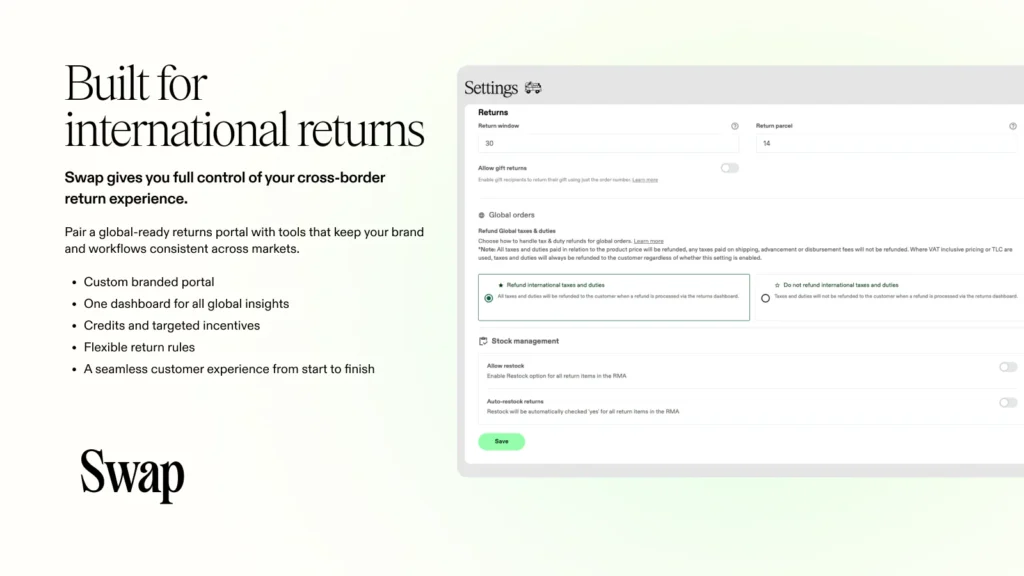
Swap covers refunds and store credit, but it doesn’t offer discount code refunds, bank transfers, or bundle-specific partial refunds. If your store relies on any of those, that gap is worth noting.
Both platforms let you build rules around your return policy- return windows, excluded products, and conditions for auto-approving or auto-denying a request. Both can generate labels automatically and process routine returns without a person touching them. Both also let you charge return, restocking, or handling fees. On this point, the two are close to even, so it shouldn’t be the deciding factor for most stores.
Synctrack and Swap both offer prepaid labels, packing slips, and QR-code returns for customers who don’t have a printer at home. Synctrack connects to more than 2,000 carriers and can automatically choose the cheapest or fastest option for each return. Swap works with multiple return carriers and integrates with Happy Returns for eligible US domestic returns. Carrier availability and routing depend on merchant configuration and return conditions.
Synctrack also gives customers a tracking page for their return and tracks inbound shipments on its own – two features that aren’t part of Swap’s app today. Where Swap pulls ahead is warehouse routing. Its reverse logistics setup connects directly to third-party logistics providers and warehouse systems like Mintsoft and Peoplevox, so a large operation can route returns to the right facility without building that connection themselves.
Both platforms sync two ways with Shopify and connect to the Gorgias helpdesk, so your support team can see a customer’s return history without leaving a ticket. Synctrack adds Shopify Flow support, so you can build your own automations around return events, and it includes a return MCP that lets AI assistants like Claude or ChatGPT take actions on returns for you. It’s also expanded beyond Shopify to support Shopline.
Swap offers open APIs and webhooks and connects to WMS and ERP systems such as Brightpearl, Mintsoft, Patchworks, and Peoplevox, alongside Gorgias and Klaviyo integrations, which matters more once you’re running several systems at once. Swap can also plug into stores outside Shopify entirely, which Synctrack currently doesn’t do.
Synctrack supports multi-store returns management for 2+ Shopify stores on the Enterprise plan. It also offers a partner portal, and on higher-tier plans, support runs through WhatsApp, Trello, or Slack instead of email tickets, which tends to be faster when something’s urgent.
Swap doesn’t currently offer multi-store management or a partner portal. Both platforms provide 24/7 live chat and role-based permissions, so your team only sees and touches what they need to.
Price is where the two products really pull apart from each other.
Synctrack uses a tiered model that starts free and grows with your store:
| Plan | Price | Returns Included | What You Get |
| Starter | Free | Up to 5/month | Basic portal, labels, email alerts |
| Professional | $19.99/month | Up to 60/month | Store credit, gift cards, exchange upsells |
| Premium | $49.99/month | Up to 120/month | Unlimited rules, automatic shipment tracking |
| Enterprise | $149.99/month | Up to 300/month | Multi-store support, WMS integration, full API access |
Swap doesn’t publish tiered pricing. Its Shopify app comes as a single plan, called Advanced, priced at $350 a month (or $3,465 a year) with unlimited returns included. Outside of Shopify, Swap typically negotiates custom, contract-based pricing for larger clients.
Put simply, Synctrack costs nothing to start and as little as $19.99 a month for full features, with plans that scale up as you grow. Swap starts above $350 a month, with one fixed plan that applies whether you’re a growing brand or a massive retailer.
Synctrack scales comfortably inside the Shopify world. Its Enterprise plan supports multiple stores and a few hundred returns a month, which covers most small and mid-sized businesses without a fuss. It isn’t built, though, for a retailer managing warehouses in five countries or processing return volumes in the millions.
Swap is built for exactly that kind of scale. Its setup handles high return volumes across regions, multiple warehouses, and even multiple legal entities under one brand. It also includes demand-planning tools that turn return data into better buying decisions for your next season. That scale comes with real cost, both in dollars and in the setup work needed to connect it to your warehouse and support systems.
Synctrack’s strengths are speed, cost, and flexibility – a free plan, fast setup, broad refund/exchange options, wide carrier reach, and faster support channels on higher tiers. Its main gap is scope: it’s Shopify/Shopline-only and lacks deep warehouse and 3PL routing.
Swap’s strengths run the other direction- a unified global portal, built-in logistics routing, and strong analytics, plus support for stores beyond Shopify. Its trade-off is cost and complexity: pricing starts above $350/month on one fixed plan, and it takes more setup work than most small or mid-sized stores need.
| Synctrack Returns | Swap Returns | |
| Pros | Fast Shopify setup | One global portal across markets |
| Genuine free plan | Built-in warehouse and logistics routing | |
| Flexible refund and exchange options | Strong analytics and demand planning | |
| Wide carrier coverage | Supports platforms beyond Shopify | |
| Support via WhatsApp/Slack on higher plans | ||
| Cons | Works only with Shopify and Shopline | Pricing starts above $350/month, single fixed plan |
| No deep warehouse/3PL routing for large, multi-country operations | Setup takes more effort | |
| Likely more than a small or mid-sized store needs |
Start with two questions:
If you run one Shopify store with a moderate number of returns and want something running by the end of the day, Synctrack is the more practical pick, especially if budget matters. Its paid plans start under $20 a month, and the free plan lets you try the portal before you commit to anything.
If you’re running a large, multi-country operation with real warehouse logistics, and you’re ready to invest in an enterprise-level system, Swap’s global routing and demand-planning tools are built to handle that kind of complexity.
A simple way to think about it:
Yes. Both offer bonus credit and pop-ups to encourage exchanges. Synctrack calls its version a retain pop-up; Swap calls its version “Shop Now.”
Synctrack offers a free Starter plan. The Professional plan includes a 7-day free trial, while Premium and Enterprise include 14-day free trials. All paid plans currently offer a $1 first-month promotion.
For most small to mid-sized stores, Synctrack is the simpler, more affordable place to start. Swap starts to make sense once your return volume and logistics needs outgrow what a standard Shopify app can handle.
When it comes to Synctrack Returns vs Swap Returns, neither is “better” – just better suited to different stages. A small Shopify store doesn’t need enterprise logistics; a global, multi-warehouse brand will outgrow a lightweight app fast. Pick based on where your store stands today, not where you hope to be in three years.
Either way, the software is only half the equation. A returns portal pays off when your policies are clear, and the process feels easy for customers. Get that right, and both platforms can do the job well.