A new kind of shipping tool started to take shape in 2026. People call it MCP tracking, and it changes the way ecommerce merchants handle everything that happens after a customer hits buy. You no longer have to log into a dashboard, copy tracking numbers one by one, or sit and wait for a report to load. Now you can just ask an AI assistant, in plain English, to find a late shipment, check how a carrier is performing, or write a quick apology to a customer. The thing that makes all of this work is the Model Context Protocol, or MCP.
This guide breaks down what MCP tracking is, why it matters for your store, and how the three leading shipping and tracking platforms put it to work. Those three are TrackMage, Easyship, and Synctrack Order Tracking. By the end, you will know which one fits your business and why.
The Model Context Protocol (MCP) is an open standard that Anthropic introduced in November 2024. It was built to fix a problem that had slowed down AI development for years. Every time a developer wanted to connect an AI assistant to a new tool or data source, they had to build a custom integration from scratch. MCP fixes that. It gives any compatible AI assistant a steady, secure way to call outside tools and pull live data.
Think of it as a universal adapter for AI. Before MCP, hooking an AI assistant up to a shipping carrier could take months of custom engineering. After MCP, you point the assistant at an MCP server, grant access, and you are done.
Adoption has been fast since the launch. Anthropic’s December 2025 ecosystem update counted more than 10,000 active public MCP servers, and the Python and TypeScript SDKs together passed 97 million monthly downloads. The Linux Foundation now governs the protocol, and ChatGPT, Cursor, Gemini, Microsoft Copilot, and VS Code all support it out of the box. In a Stacklok survey of senior software leaders, 41% said they were already running MCP in production in some form. On the ecommerce side, Stripe, PayPal, Shopify (with four official MCP servers), and most major shipping platforms have adopted it too.
“Where Is My Order?”, known in the industry as WISMO, is the most common question in ecommerce support. WISMO tickets make up 20% to 80% of all incoming support requests, depending on the season and the platform. For a mid-size brand that handles 500 WISMO questions a day, that adds up to more than $75,000 a month, all for a question that you could prevent in most cases.
This is exactly where AI shines. Brands that use AI to automate WISMO report drops of 40% to 75% in WISMO volume. Average response times fall from 12 to 18 hours down to under 30 seconds, and support costs drop from about $12 per ticket to under $3. Before MCP, getting those results meant building custom AI integrations that could take months. With MCP, you can set up the same workflows in minutes.
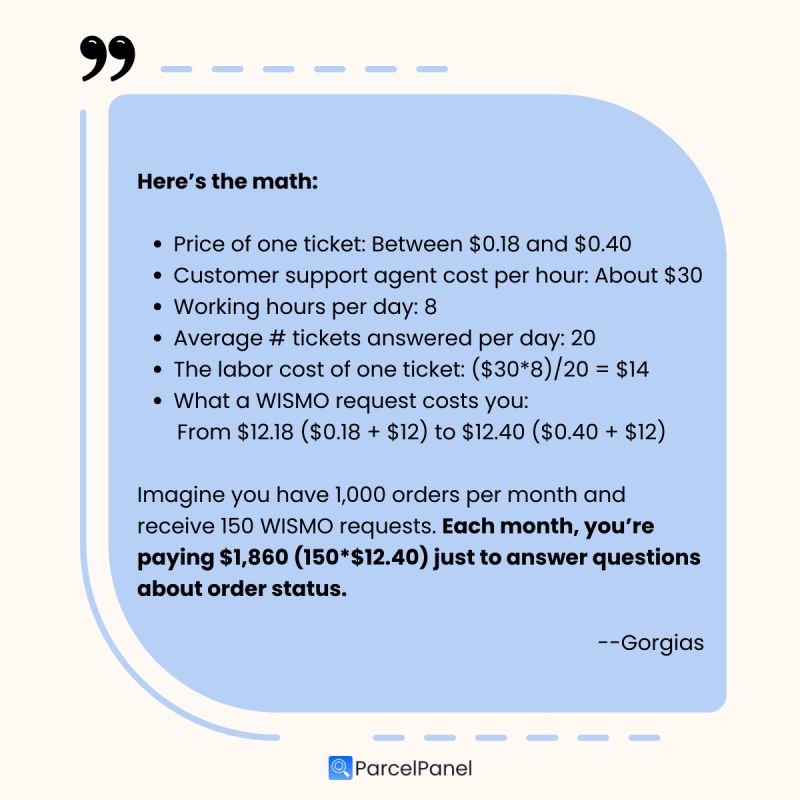
The math is hard to ignore. When a single repetitive question eats up most of your support queue, every hour your team spends on it is an hour they are not spending on harder problems that actually need a human. Cutting WISMO volume by even half frees up real time and real money, and it does it without hiring more agents.
Without MCP, a support agent who wants to check a late order has to jump between tabs. Open the helpdesk, copy the order number, switch to the tracking platform, look up the carrier status, switch again to the carrier portal for the details, then write a reply by hand. At scale, this slows everyone down and invites mistakes.
MCP tracking folds that whole process into one conversation. The agent types something like “Where is order #1284, and draft a delay notice for the customer”, and the AI assistant pulls the live tracking data, checks the delay, and writes a fitting reply, all in a single step.
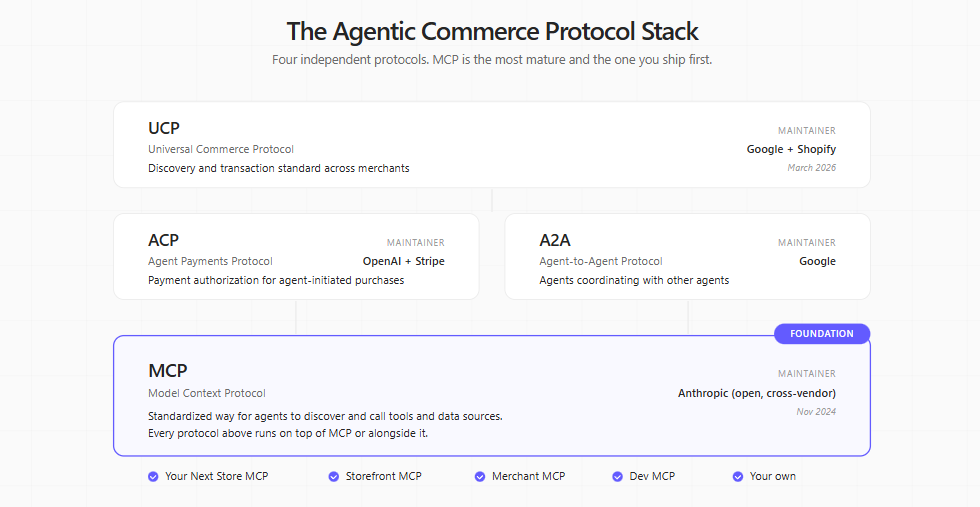
MCP marks the moment the commerce stack moves into agentic commerce, the stage where AI does not just answer questions but actually takes action. Payments moved into AI clients first, with Stripe MCP on February 20, 2025 and PayPal’s MCP in April 2025. Storefronts and support came next, and now logistics has joined in. When Shippo launched its MCP server in December 2025, it called itself “the first agentic shipping platform.” By the middle of 2026, every major layer of the stack (checkout, payments, fulfillment, returns, and order tracking) will have an MCP server you can use.
That order of events matters. Once payments and checkout could run through AI, it was only a matter of time before the rest of the post-purchase chain followed. Order tracking is one of the last pieces to get an MCP layer, and it is also one of the most useful, because tracking is where customers ask the most questions and where support teams spend the most time.
Before we compare how each one handles MCP, it helps to know what each platform actually does at its core.
TrackMage is a Shopify post-purchase tool. It gives you branded tracking pages, automatic customer notifications, and carrier performance reports. It works with 1,620+ carriers and adds upsell blocks and notification rules. Its MCP setup is built for logistics and shipment tasks.
Easyship is a global shipping platform used by 100,000+ merchants in 200+ countries. Its main job is comparing carrier rates and creating labels, with discounts of up to 91% off retail rates across 550+ couriers. Its MCP server launched in April 2026 with 25 tools that cover the whole journey: address checks, rate comparison, labels, tracking, returns, analytics, and customs.
Synctrack Order Tracking (by Omega) is a Shopify order tracking app focused on the customer experience after the sale. It works with 2,880+ carriers and tracks China-based couriers like Yanwen, YunExpress, and 4PX very well. It also offers branded tracking pages and PayPal/Stripe sync. Its MCP AI Assistant launched on June 9, 2026, making it the newest of the three.
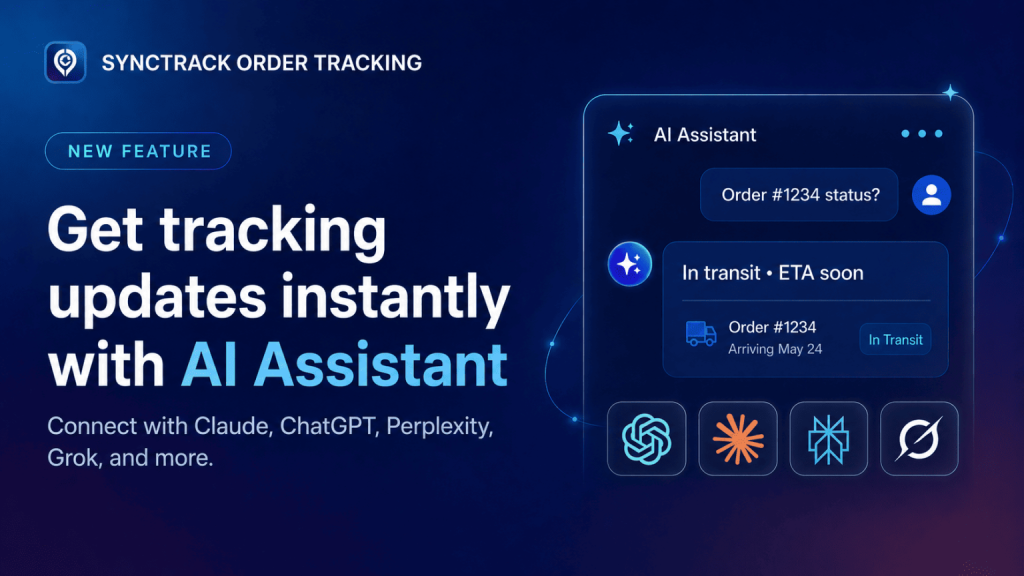
Synctrack’s MCP AI Assistant, live since June 9, 2026, takes a different path from the other two. Instead of a developer API or a registry listing, it sits right inside the Synctrack dashboard as a no-code, one-click setup. It is built for operations teams and support agents who live in AI tools every day but are not developers.
What it gives you:
Set up: A one-click OAuth connection under Settings → AI Assistants in the Synctrack dashboard. The deepest integration is with Claude.ai on paid accounts (Pro, Team, Enterprise). ChatGPT, Perplexity, and Grok work through a custom MCP URL.
Security: Synctrack’s MCP is internal-only, never customer-facing. Tracking data moves only when a team member asks a question. Anthropic does not use these data flows to train models, and access tokens auto-revoke after 90 days of no activity.
Pricing: The MCP AI Assistant is free on every Synctrack plan, including the free tier, and it does not count against your monthly shipment quota. Paid plans start at $9.99 a month for 600 shipments and scale to $99.99 a month for 10,000 shipments.
Carrier coverage: 2,880+ carriers, with real depth in China-origin couriers like Yanwen, YunExpress, 4PX, USPS, DHL, UPS, and FedEx.
What sets it apart: Synctrack MCP is the only one of the three built as a native dashboard feature with a guided, no-code setup. If your team already uses Synctrack’s tracking pages and notifications, turning on AI assistant access takes no developer help and costs nothing more. Its use cases lean toward support work, drafting replies, surfacing late orders, and running carrier audits, rather than transactional shipping tasks.
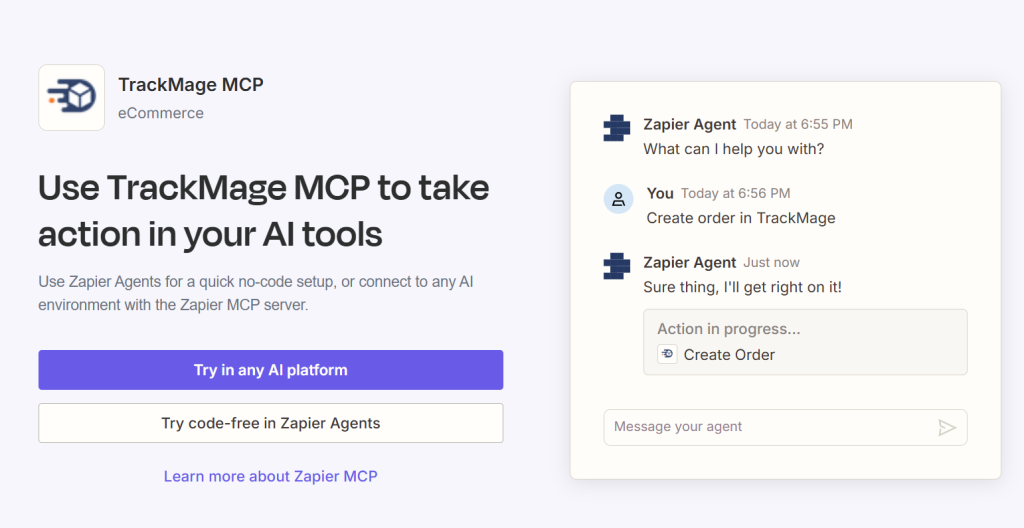
TrackMage’s MCP server is a developer-first build, listed on the official MCP registry at mcpservers.org and mcpmarket.com. You can also reach it through Zapier MCP, which means merchants without a technical team can connect it to AI tools without writing any code.
What it gives you:
Authentication: OAuth with client credentials.
What sets it apart: TrackMage’s MCP uses a “Find or Create” pattern for both orders and shipments. That makes it handy for AI agents that need to check whether a record already exists before they make a new one, which is a common need in automated fulfillment. Its carrier performance scores, reachable through the Zapier connector, also let AI agents spot which carriers are falling behind without building a custom report.
One limitation: TrackMage’s MCP is still a community and developer integration. It is not built into the TrackMage dashboard as a one-click setup, so you need either developer resources or a Zapier account to turn it on.
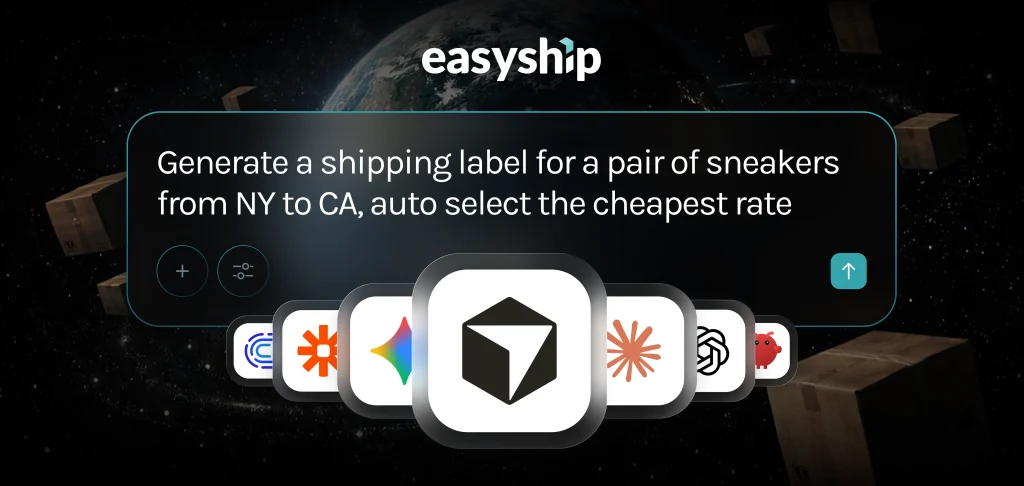
The Easyship MCP Server is the most technically complete of the three. It exposes 25 callable tools across eight categories, including Rates, Shipments, Pickups, and Billing & Analytics.
What it gives you:
Authentication: Bearer token (remote at mcp.easyship.com/mcp), or local through Python uvx.
Works with: Claude (Desktop and Code), ChatGPT (through the OpenAI Responses API), Cursor, Windsurf, Gemini CLI, Codex CLI, VS Code, n8n, Make, Zapier, and Activepieces.
Pricing context: The Easyship MCP Server costs nothing extra for any Easyship account holder. The base plan starts free with limited shipments, and paid plans begin at $29 a month for 500 shipments. The pre-negotiated discounts of up to 91% off retail rates work through the MCP server just as they do in the dashboard, so an AI agent can issue the cheapest label directly, not just look at prices.
What sets it apart: Easyship MCP is the only one of the three that brings rate shopping, label buying, customs documents, landed cost math, and returns together in one place. If you ship internationally or juggle several carriers, this is the most powerful MCP server out there. As Easyship’s CTO put it:
“The shipping technology layer is complex, with dynamic rates, unique carrier logic, and customs rules that don’t compress easily into a single API endpoint. We built the Easyship MCP Server so any AI agent can tap into 550+ global services with a single prompt and get back a real, printable label.”
Here is how the three platforms line up side by side across the features that matter most for AI-powered order tracking.
| Feature | TrackMage MCP | Easyship MCP | Synctrack MCP |
| Launch date | 2025 (registry) | April 2026 | June 9, 2026 |
| Carrier coverage | 1,620+ | 550+ | 2,880+ |
| Setup method | Developer / Zapier | Developer/token | No-code dashboard |
| Rate comparison | No | Yes (550+ couriers) | No |
| Label generation | No | Yes | No |
| Shipment tracking | Yes | Yes | Yes |
| WISMO automation | Yes | Yes | Yes (support-focused) |
| AI reply drafting | No | No | Yes |
| Returns management | No | Yes | No |
| Customs / landed cost | No | Yes (200+ countries) | No |
| Carrier analytics | Yes (performance scores) | Yes (spend breakdown) | Yes (on-time audit) |
| International shipping | Tracking only | Full cross-border | Tracking only |
| MCP cost | Free (Zapier tasks) | Free (with account) | Free on all plans |
| Paid plan starts | $8.99/mo (Shopify) | $29/mo | $9.99/mo |
| Claude integration | Via Zapier | Yes (direct) | Yes (one-click) |
| ChatGPT integration | Via Zapier | Yes | Yes |
| Non-developer setup | Yes (via Zapier) | No (token needed) | Yes (dashboard UI) |
Scores range from 0 to 1. A score of 0.8 to 1.0 indicates excellent citation performance, 0.6 to 0.8 is good, 0.4 to 0.6 is average, and anything below 0.4 means your content is rarely being cited by AI models and needs improvement.
Yes. Through standard integration platforms and provider-backed servers, developers can connect AI models to e-commerce platforms (like Shopify or Magento) to automatically pull data. For example, the order_fulfillment_tracker tool allows an AI to identify bottlenecks in order processing, while the ecommerce_orders_one tool allows the AI to fetch a specific order’s status and tracking information based on its ID.
MCP tracking is not just another feature. It changes how order tracking software works. Instead of dashboards that only show you information, MCP-powered tools become active helpers, answering questions, flagging problems, and even drafting replies for you.
So pick the tool that fits your biggest pain. If slow WISMO replies are slowing your Shopify store down, Synctrack’s free, no-code MCP AI Assistant is the easiest place to start. If international shipping is your challenge, Easyship’s 25-tool server has the most power. Either way, MCP tracking is quickly becoming the new normal, and now is a great time to try it.