If you sell online to shoppers in Europe, you’re working under one of the strictest return systems in the world. EU return policy gives every customer 14 days to send back an online order, no reason needed. And as of June 19, 2026, exercising that right got a lot easier. A new EU rule now says every online store with EU customers must add a clear “withdrawal button” to its storefront, basically a one-click way to start a return. This guide breaks down what you need to know: the rules that have shaped EU returns for over ten years, the 2026 update that changes how those rules work, what happens if you ignore it, and how to get your shop ready.
EU return rules now sit in three layers:
For Shopify merchants, the technical side is the easy part. Returns settings and compliance apps can get you most of the way in well under an hour. The real opportunity is building a returns experience around these rules that turns a legal requirement into a reason customers trust you and buy again.
EU returns rules come from the Consumer Rights Directive (Directive 2011/83/EU), which took effect across every EU country in 2014. It set one shared standard for returns that applies in all EU markets, no matter where the seller is based.
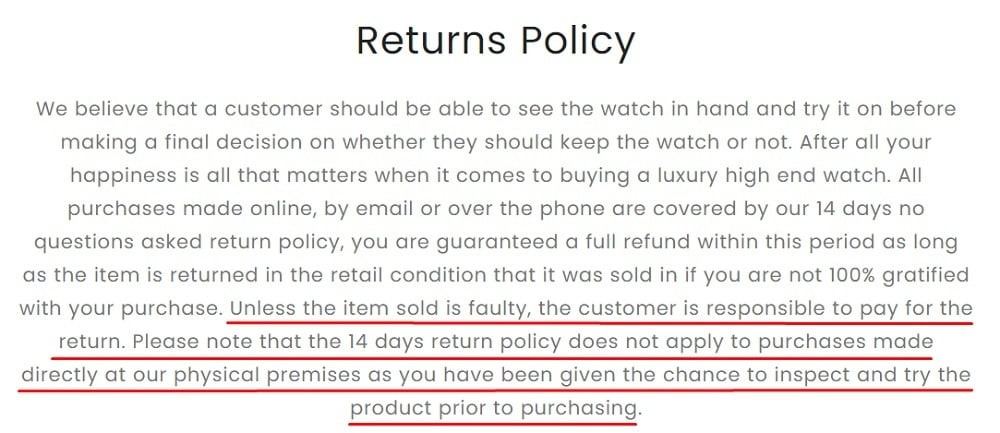
The heart of the system is the right of withdrawal. Customers get 14 calendar days to cancel an online order for any reason, with no explanation required.
The clock starts the day the customer (or someone they name) receives the goods. For services and digital content, it starts the day the contract is made. If day 14 lands on a weekend or holiday, the deadline moves to the next working day.
This right isn’t optional. You can’t remove it or shorten it in your own terms and conditions. Any clause that tries to waive it simply doesn’t hold up under EU law.
There’s a strong penalty built in for sellers who don’t tell customers about the withdrawal right. If you fail to clearly explain it, the 14-day window stretches to a full year plus 14 days. That one rule alone makes clear disclosure worth getting right.
When a customer cancels within 14 days, you have to refund the full price of the item and the standard shipping they paid. You don’t have to cover an express upgrade they chose on their own.
The refund is due within 14 days of getting the cancellation notice or proof that the goods are on their way back, whichever comes later. You can hold the refund until the item arrives or the customer shows they’ve sent it.
For a normal change-of-mind return, the customer usually pays return shipping, but only if you told them so before the sale. If you didn’t make that clear up front, the cost falls on you. For large or bulky items, you have to give at least an estimate of return shipping before the customer buys.
There’s a different rule for faulty or wrongly described goods. That’s a guarantee claim, not a change of mind, and the seller always covers return shipping.
Read More: How to Decide Who Pays for Return Shipping?
Not every purchase comes with the 14-day right. The Consumer Rights Directive lists clear exceptions:
| Exclusion Category | Examples |
| Perishable goods | Food, flowers, items with short shelf lives |
| Custom or personalized items | Made-to-measure clothing, engraved products |
| Sealed hygiene or health goods opened after delivery | Cosmetics, medical devices, underwear |
| Digital content once a download begins | Music, software, films (if the customer consented) |
| Time-specific services | Hotel bookings, car hire, concert tickets, flights |
| Newspapers and periodicals | (Subscriptions are still covered) |
| Public auction purchases | Items bought through an auction format |
| Urgent home repairs | Specifically requested by the customer |
| Goods with fluctuating market prices | Financial instruments, cryptocurrencies |
One thing to keep straight: these exceptions only apply to change-of-mind returns under the 14-day rule. They don’t free you from the 2-year guarantee of conformity, which covers every product. That guarantee requires a repair, replacement, or refund for faulty goods within two years of purchase, whatever the category.
One part of the law trips up a lot of sellers: where it applies. Any business selling online to EU shoppers falls under the Consumer Rights Directive, no matter where the business sits. That includes sellers in the US, China, Southeast Asia, or anywhere else.
EU consumer law follows the shopper, not the seller. Putting your terms under another country’s law won’t get you out of it.
In 2022 and 2023, the EU widened these protections through the Omnibus Directive (Directive 2019/2161). It extended the right of withdrawal to digital goods, digital content, and digital services, even when the customer pays with personal data instead of money.
That matters for a lot of modern stores and SaaS tools. If you offer a “free” product or service where the real payment is the user’s data (their email, behavior data, and so on), EU customers still get a 14-day right to withdraw. The main exception is when you only process that data to meet a legal duty, or when the service is fully delivered with the customer’s prior consent.
The Omnibus Directive also brought in rules on price transparency and fake reviews. You have to flag when a shown price comes from automated personalization, and review systems need a way to check that reviews are real.
The biggest shift to EU returns rules in over a decade landed on June 19, 2026.
Directive (EU) 2023/2673 updates the Consumer Rights Directive with a new Article 11a. It adds a required “online withdrawal function,” better known as the withdrawal button, or in plain terms, one-click returns.
The rule doesn’t create a new right. EU customers already had the 14-day withdrawal right. What changed is how they use it. Before, that right was often buried under menus, or it meant writing an email, filling out a PDF, or hunting through a contact page. Technically legal, but a pain in practice.
The idea behind the new rule is stated plainly in the directive: canceling a contract should be as easy as signing up for it. If buying took one click, so should withdrawing.
One detail worth knowing: the rule covers contracts made through an online interface, meaning a website or app. Orders placed by phone, email, or post aren’t part of it.
The rule applies to any EU-based seller offering goods, services, subscriptions, or digital content online to consumers. It also applies to any non-EU seller whose online activity is aimed at EU shoppers. That includes accepting EU payment methods, shipping to EU addresses, or translating your store into an EU language.
There’s no size limit. A solo Shopify merchant and a large retailer face the same rule. Pure B2B sellers are off the hook, but if regular consumers can also buy, you’re in scope.
The withdrawal button isn’t just a graphic. It’s a working feature with specific requirements:
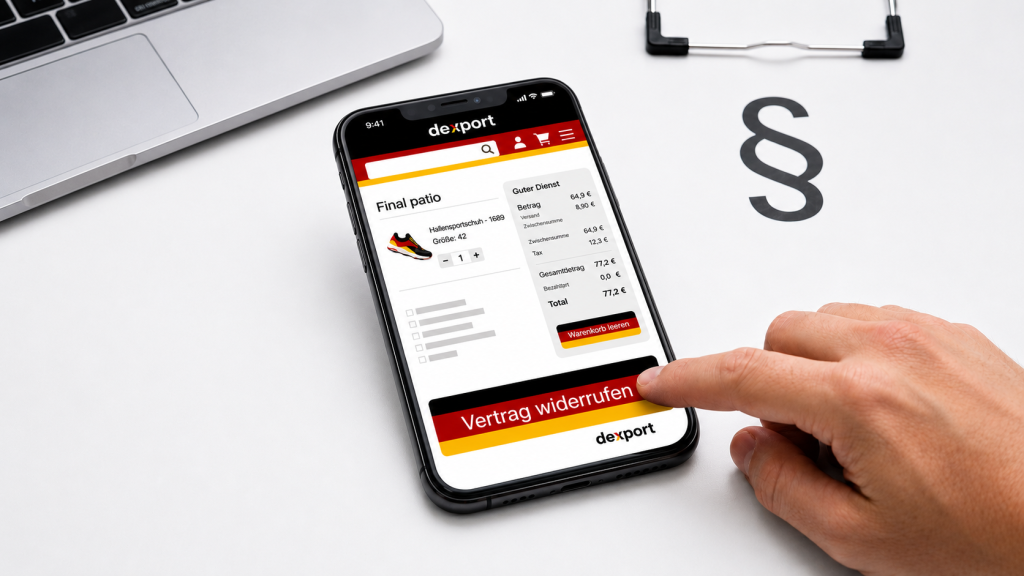
Skipping the withdrawal button gets expensive on more than one front.
The withdrawal window jumps. A seller who doesn’t provide the function can see the withdrawal period stretch to 12 months and 14 days, on every order from every EU customer.
Fines. In Germany, one of the EU’s biggest ecommerce markets, fines reach up to €50,000. For infringements that affect several EU countries, penalties can climb to 4% of annual turnover or up to €2 million.
Competitor and watchdog action. In Germany and other countries, competitors and consumer groups can file warning letters and injunctions against sellers who don’t comply, and they tend to move fast.
Dark-pattern risk. Designs that make withdrawal deliberately hard can also count as unfair commercial practices under EU law, which brings extra penalties.
The new EU rule is clear. You can’t make EU shoppers give a reason, contact support, or fill out a survey before they cancel an order. You also have to send them a proper withdrawal confirmation. Setting all of this up on your own, with the right wording, takes time.
If your return flow still forces a reason or hides the cancel option, you’re not following the rule. That puts you at risk of the 12-month extension and fines of up to €2 million or 4% of your EU sales. Building a separate EU process by hand is slow and easy to get wrong. On top of that, you’d have to manage EU returns apart from your normal ones, which adds even more work.
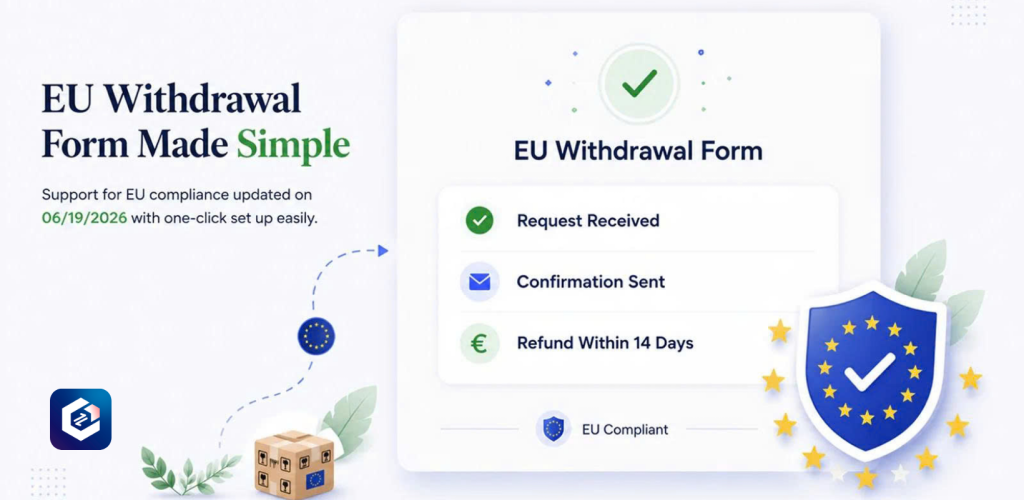
Synctrack Returns & Exchanges fixes this with its EU Withdrawal form feature. You turn it on with one toggle, with no extra setup. (It’s available on the Professional plan and up.)
Once it’s on, here’s what happens:
Best of all, you don’t get a second system to manage. It reuses your current return portal, emails, and management screen, so EU withdrawal requests show up in your normal return list like any other return.
With the rule now in force, the EU Withdrawal form is the fastest way to get your shop ready. Flip one switch, and your EU returns meet the new requirement while the rest of your returns keep working as usual.
Returns work differently depending on the market. Here’s how the EU stacks up against the US and UK:
| Dimension | EU | United States | United Kingdom |
| Mandatory right of withdrawal | Yes, 14 days, no reason needed | No federal mandate (store policy governs) | Yes, 14 days (kept after Brexit) |
| Applies to digital goods | Yes (Omnibus Directive) | No general mandate | Yes |
| Who pays return shipping | Consumer, if disclosed in advance | Seller’s choice | Consumer, if disclosed in advance |
| Mandatory return mechanism | Yes, withdrawal button from June 19, 2026 | No | Not yet legislated |
| Penalty for non-disclosure | Extends period to 12 months + 14 days | No equivalent | Extends to 12 months |
| Legal guarantee period | 2 years for goods | Varies by state (often 1 year implied) | 6-year limitation period |
| Cross-border reach | Applies to any seller targeting EU consumers | US law applies to US-based sellers | UK law applies |
If you sell to EU shoppers, treat June 19, 2026, as a starting line, not a finish line. Set up the button, then make returns something your customers actually like dealing with.