For most stores, a return is a cost you absorb after the fact. For this US-based consumer electronics retailer, it had also become a bottleneck: customers with a genuine problem had no way to start a return themselves, so every request landed on the team manually.
Within seven weeks of switching to Synctrack Returns & Exchanges, roughly nine in ten return requests were being started by customers themselves, every refund was processed automatically, and – because of one specific feature – the team began solving customer problems before the product was even shipped back.
Contents
A US-based consumer electronics retailer selling direct to consumers on Shopify, shipping worldwide. The catalog is broad and accessory-led – phone and laptop accessories, audio, wearables, gaming, camera gear and small home appliances – spanning many manufacturers and hundreds of SKUs at a low average order value.
That combination makes returns unusually awkward. Electronics carry a high rate of “it doesn’t work the way I expected” returns, where the customer isn’t wrong but the product isn’t faulty either. And when the item is a cable or a watch band being shipped back across a border, the logistics of the return can cost more than the product itself.
Three things raise the stakes further:
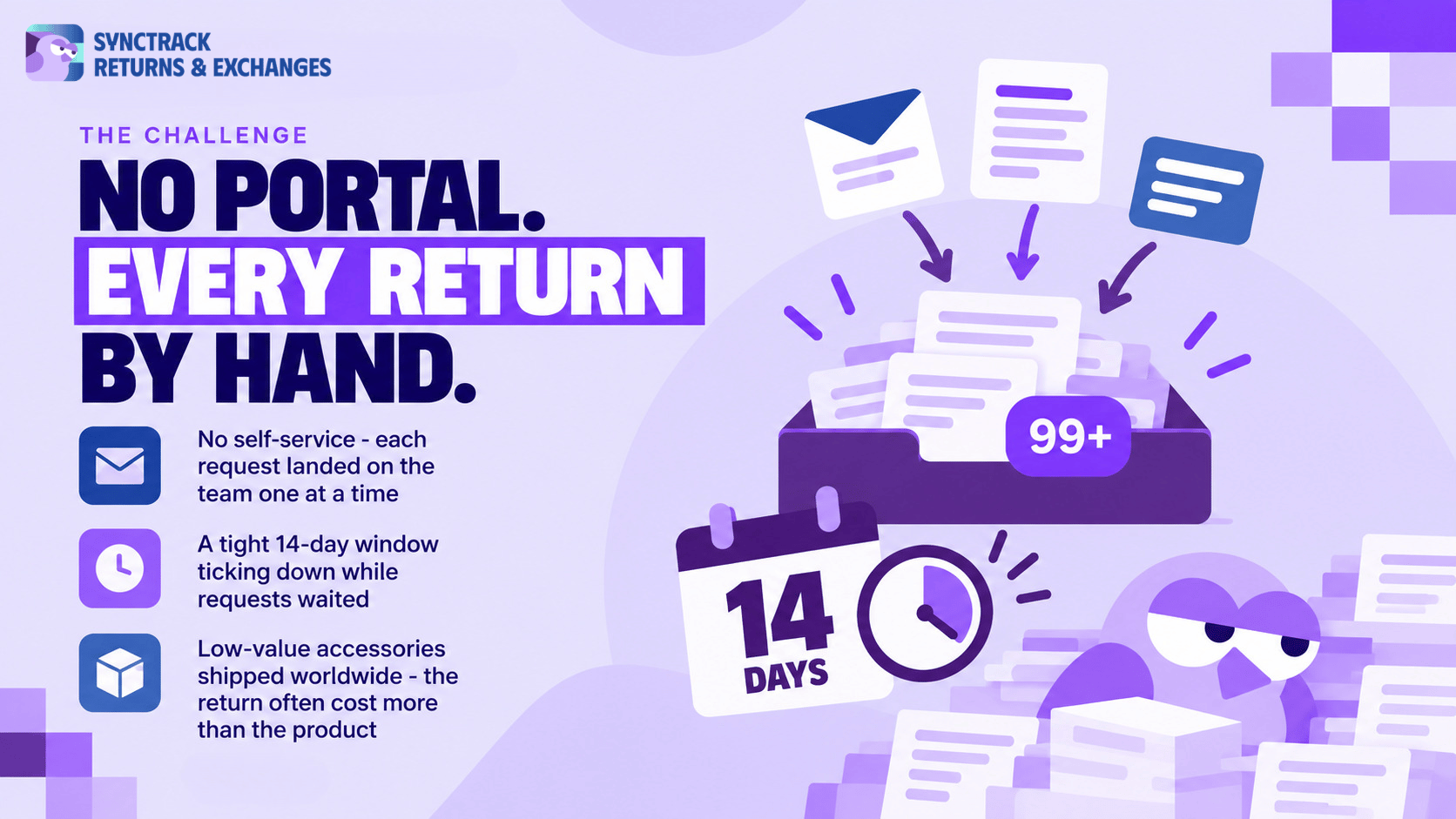
Without a customer-facing flow, the store hit three connected problems:
“One of the biggest challenges we had was that customers who experienced an issue or simply wanted to return a product didn’t have an easy, convenient portal to initiate the process themselves. This could make the return experience more difficult than it needed to be.”
The retailer rebuilt returns around three moves – a self-service portal at the front, evidence tied to each return reason, and automation behind the scenes.
The first move was a branded, customer-facing return portal to replace ad-hoc requests. Customers now start returns themselves, at the moment they hit a problem, without contacting support first.
Crucially, the retailer treats the portal as a primary navigation item – “Start a Return” sits in the main menu and the footer, next to order tracking – rather than burying it in a policy page. For a store whose support runs asynchronously, that turned the portal into the front door for return traffic almost immediately.
Three return paths run side by side, so the right path is matched to the situation instead of forced on every case:
Pre-paid label and any-carrier are used in roughly equal measure, and the no-shipment path exists precisely for the accessories where return freight would cost more than the item.
The second move was to configure specific return reasons to require photos and, where appropriate, video before a request can be submitted.
This is the feature the retailer names as the single biggest difference – and its value turned out to be broader than fraud prevention. Video submitted at intake often shows the team exactly what is wrong, so the problem can be identified and a solution offered before the product ships back at all.
For a cross-border store selling accessories, that shortcut is worth more than it looks. Diagnosing from a 20-second clip can resolve a case that would otherwise have cost international return freight on an item worth a fraction of the shipping – and it does it inside the 14-day window rather than after it.
“The video requirement in particular does a great job of helping prevent misuse while also benefiting genuine customers. In many cases, customers’ videos allow us to understand the problem before they even send the product back, which means we can often identify the issue and provide a solution much faster.”
The third move removed manual work from resolution. Refunds were switched to automatic processing, and return reasons were mapped to fee outcomes – return shipping cost deducted from the refund, and a return handling fee on certain reasons – so cost responsibility is applied consistently and transparently at the point of request, rather than negotiated case by case afterwards.
The third move removed manual work from resolution. Refunds were switched to automatic processing, and return reasons were mapped to fee outcomes – return shipping cost deducted from the refund, and a return handling fee on certain reasons – so cost responsibility is applied consistently and transparently at the point of request, rather than negotiated case by case afterwards.
👉 Tying fees to the return reason, and stating them up front, is what lets a store apply return costs fairly without arguing every case over email.
Here is what the first seven weeks of live use looked like across the store’s return requests:
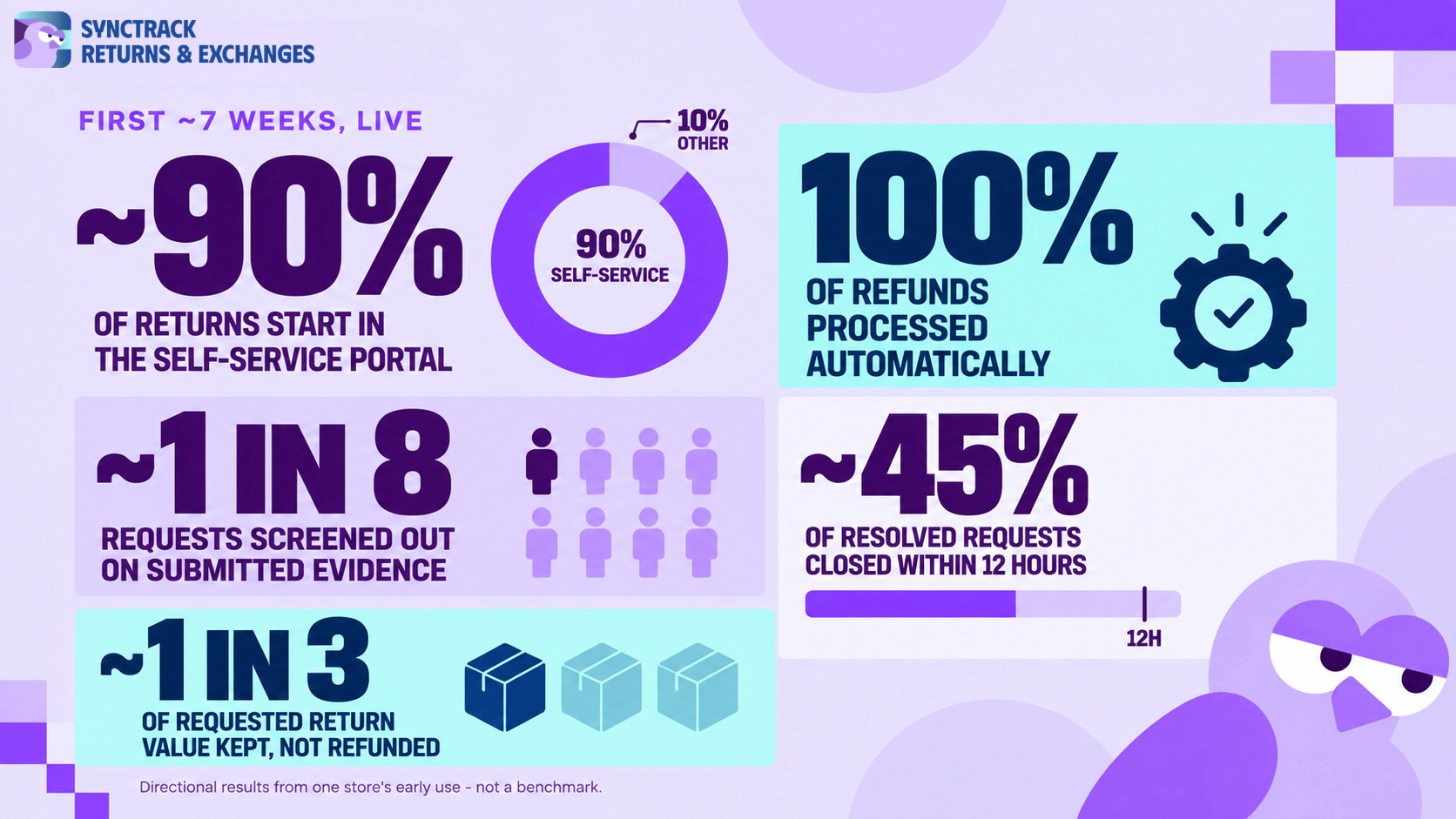
👉 These figures come from one store’s first seven weeks of live use. They’re directional – an early read on how self-service returns behaved for this retailer, not a benchmark to expect for every store.
The pattern across all four changes is the same: structure at intake – a self-service portal, evidence tied to the return reason, automated refunds and fees, and automatic status updates – turns returns from a manual, after-the-fact cost into a process that can diagnose and resolve a problem while the customer is still in the window.
“Synctrack Returns is much more than a simple return portal. It’s almost a problem-solving machine. It has been an incredibly valuable tool for our business, and it’s clear that a lot of thought has gone into how the entire experience works.”
💡 If your Shopify returns still run through a shared inbox, a self-service portal is the fastest place to start. Synctrack Returns & Exchanges gives customers a branded portal to start returns themselves, lets you require photo and video evidence by return reason, and automates refunds, fees and status updates – so returns stop being a cost centre and start solving problems.