Choosing between Airwallex and Stripe is not simply a matter of comparing card fees. Stripe is strongest as a flexible payment and revenue platform, while Airwallex brings payment acceptance, multi-currency accounts, foreign exchange, transfers, and company spending into one system. The better option depends on what happens to the money after a customer pays.
Both platforms accept online payments, support local methods, handle recurring billing, and serve businesses selling across borders. Stripe is built first around payments and software. Airwallex connects payment processing with multi-currency accounts, FX, transfers, cards, and expenses.
| Area | Airwallex | Stripe |
| Best overall fit | Global companies managing money across currencies and markets | Internet businesses that need flexible payment and revenue infrastructure |
| Online payments | Cards, wallets, bank methods, and 160+ local payment methods | Cards, wallets, bank methods, BNPL, stablecoins, and 100+ payment methods |
| Presentment currencies | 130+ supported currencies | 135+ supported currencies |
| Multi-currency funds | Wallet and Global Accounts; like-for-like settlement in 20+ currencies on the US plan | Multi-currency settlement and conversion, subject to country and account eligibility |
| FX and transfers | Core part of the product, with local and SWIFT payouts | Available through payment balances, Treasury, Connect, and Global Payouts, with regional limits |
| Subscription billing | Subscriptions, invoices, usage-based and hybrid billing | Subscription,invoicing, and usage-based billing with additional revenue tools |
| Platforms and marketplaces | Connected Accounts and embedded finance APIs | Stripe Connect and a large platform ecosystem |
| In-person payments | Available by market; the US page lists POS as coming soon | Stripe Terminal offers in-person payment tools |
| Company spending | Corporate cards, expenses, reimbursements, and bill pay | Issuing and Treasury are available, but access depends on market and use case |
| Developer flexibility | APIs, SDKs, checkout components, plugins, and embedded finance | Extensive APIs, SDKs, prebuilt UI, Connect, and a large developer ecosystem |
Short answer: Choose Stripe when payment customization, software integrations, subscriptions, tax tools, or platform monetization matter most. Choose Airwallex when the bigger problem is collecting, holding, converting, and spending money across countries. Some businesses use both because those needs can overlap without being identical.

Airwallex is a global payments and financial operations platform. It offers online payments, multi-currency accounts, FX, international transfers, corporate cards, expense management, bill pay, billing, and embedded finance.
Payment acceptance connects directly with the rest of the money workflow. A US company selling in the UK may accept GBP, keep it in GBP, pay a UK supplier from that balance, or convert it later. Airwallex’s US Explore plan lists more than 20 currencies for holding and like-for-like settlement, plus local transfers to over 120 countries. Access still depends on the business’s country, approval, and chosen features.
Learn More: Airwallex Payment Gateway: How It Works, Fees, Features, and Safety

Stripe is a payments and financial infrastructure platform known for its APIs and developer tools. Businesses can use a hosted checkout, payment links, embeddable components, or a custom integration. Its products cover Billing, Invoicing, Tax, Radar, Connect, Terminal, Issuing, and Treasury.
Stripe is strongest when payments are part of the product itself. A SaaS company can manage subscriptions and usage pricing, while a marketplace can onboard sellers and route funds through Connect. Stripe supports charges in more than 135 currencies, although settlement and payout options depend on the business country and bank setup.
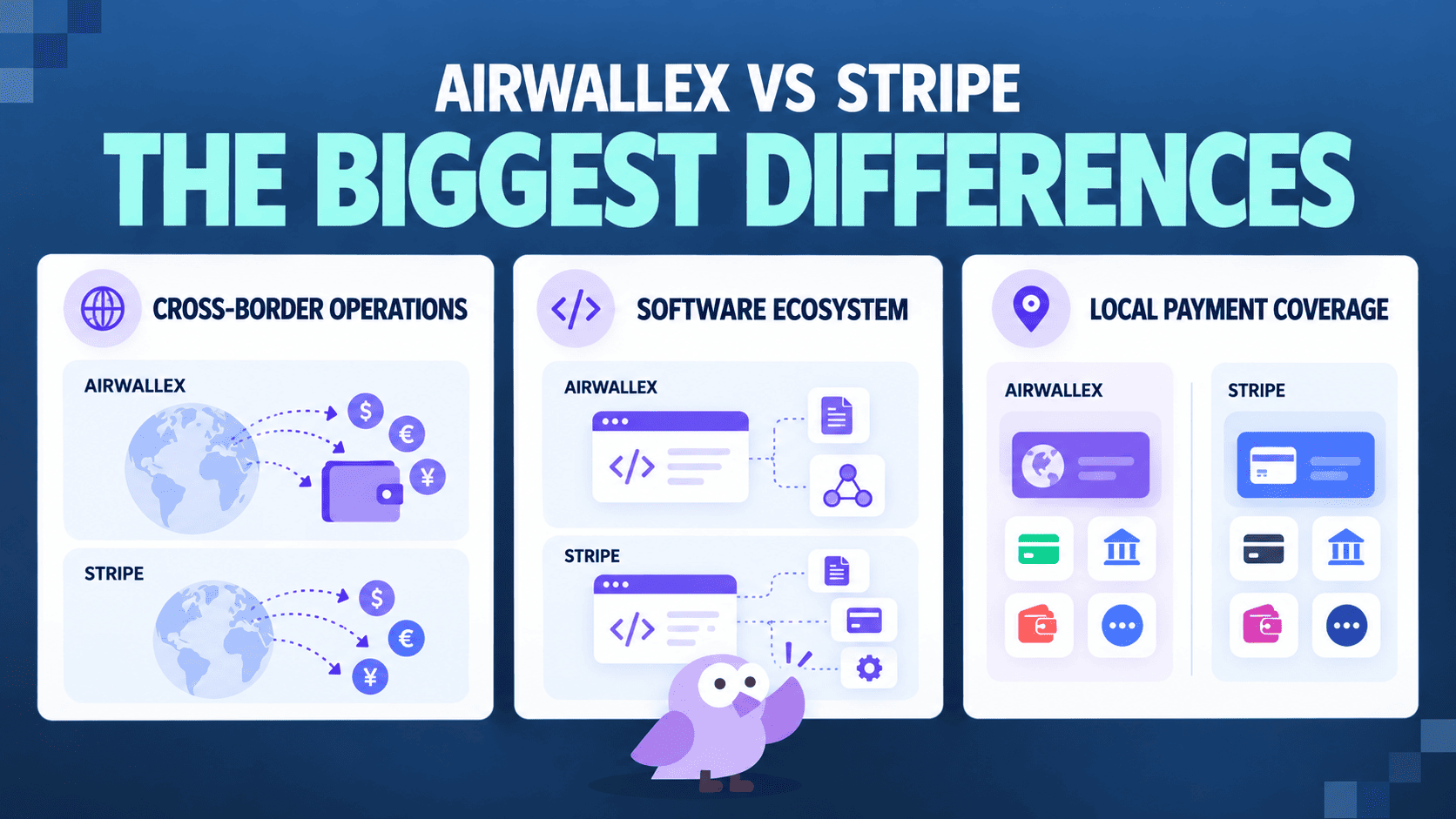
The two platforms overlap in many feature lists, so a basic checkbox comparison can be misleading. The more useful question is how each platform handles the full path from checkout to usable business funds.
Airwallex treats payment acceptance, currency balances, FX, transfers, cards, and expenses as connected parts of the same system. That makes it attractive to companies with suppliers, employees, contractors, or legal entities in several countries.
Suppose an ecommerce company earns USD, GBP, and EUR. If it also pays advertising costs and vendors in those currencies, immediate conversion into one home currency may create avoidable FX costs. Airwallex can let the company hold supported currencies and use them for later payments. It also offers Global Accounts with local bank details in supported regions, helping businesses receive bank transfers without opening a traditional bank account in every market.
Stripe has expanded beyond payment processing. It supports multi-currency settlement, instant currency conversion, Treasury, Issuing, and Global Payouts. Still, access is more dependent on the merchant’s country and product eligibility. For example, according to Stripe’s current Global Payouts documentation, Stripe Global Payouts is available to US and UK sending accounts, and cross-border payouts for US senders are in public preview. Some recipient countries and currencies are in private preview and need separate access.
Airwallex usually presents cross-border treasury as a standard workflow. Stripe’s financial services are more modular and may have narrower regional access.
Stripe gives product and engineering teams many ways to build. A small company can start with Payment Links or hosted Checkout, while a larger team can use Elements and APIs for more control. The same account can add recurring billing, tax calculation, marketplace onboarding, fraud rules, in-person payments, or revenue reporting as the business grows.
Stripe Connect is a major advantage for marketplaces and software platforms. It can onboard connected accounts, collect identity information, route payments, manage payouts, and let the platform earn revenue from transactions. Airwallex also offers Connected Accounts and embedded finance APIs, including payment acceptance, accounts, FX, payouts, and issuing. However, businesses should compare the exact countries, onboarding model, liability structure, and required features rather than assuming the two products work in the same way.
Stripe also has a broad public ecosystem of developers, tutorials, and third-party integrations, which can make custom implementation easier.
Airwallex advertises cards and more than 160 local payment methods. Its documentation covers global cards, wallets, bank transfers, direct debit, buy now, pay later, and market-specific options. The exact list changes by the shopper’s location, the merchant’s location, currency, and integration type.
Stripe advertises more than 100 payment methods. It supports major cards and wallets plus regional methods such as ACH Direct Debit, SEPA Direct Debit, iDEAL, BLIK, Bancontact, Pix, UPI, and Klarna. Again, availability varies by business country, customer country, currency, and product.
A higher global count does not automatically mean better checkout coverage. List the top customer markets, identify the methods shoppers use there, and check whether each one works with subscriptions, refunds, disputes, and the chosen integration. An Asian ecommerce brand may prioritize specific wallets, while a US B2B SaaS company may care more about cards and ACH.
There is no universal answer because fees vary by the merchant’s country, card origin, payment method, currency conversion, settlement choice, and negotiated contract. Published US pricing provides a useful example, but it should not be applied to businesses registered elsewhere.
As of October 24, 2026, the published US pricing pages for Airwallex and Stripe list the following standard online card rates:
| US pricing example | Airwallex | Stripe |
| Domestic online card | 2.80% + $0.30 | 2.90% + $0.30 |
| International card | 4.30% + $0.30 | 2.90% + $0.30, plus 1.50% for an international card |
| Currency conversion | 0.50% above interbank rates for major currencies; 1.00% for others | An extra 1.00% when payment currency conversion is required; other conversion products have separate pricing |
| Subscription or usage billing | 0.50% per successful transaction, on top of payment fees | Pay-as-you-go Billing at 0.70% of Billing volume, on top of payment fees |
| Base monthly plan | Explore is $0 per month, with up to 10 free Spend users | Standard payments pricing has no setup or monthly fee |
For a $100 domestic card payment, the published processing fee is $3.10 with Airwallex and $3.20 with Stripe. For an international card, Stripe’s listed US rate becomes 4.40% plus $0.30 before conversion, or 5.40% plus $0.30 when conversion is required. Airwallex lists 4.30% plus $0.30, while like-for-like settlement may avoid immediate conversion for supported currencies.
That does not mean Airwallex will always be cheaper. A company may qualify for custom pricing. Its payment mix may include bank methods with different rates. Refunds, disputes, instant payouts, FX, billing, tax, and platform fees can change the total. The right calculation uses real transaction data, not one headline percentage.
Build a cost model with at least these inputs:
For a global company, FX and transfer fees can outweigh a small difference in card rates.
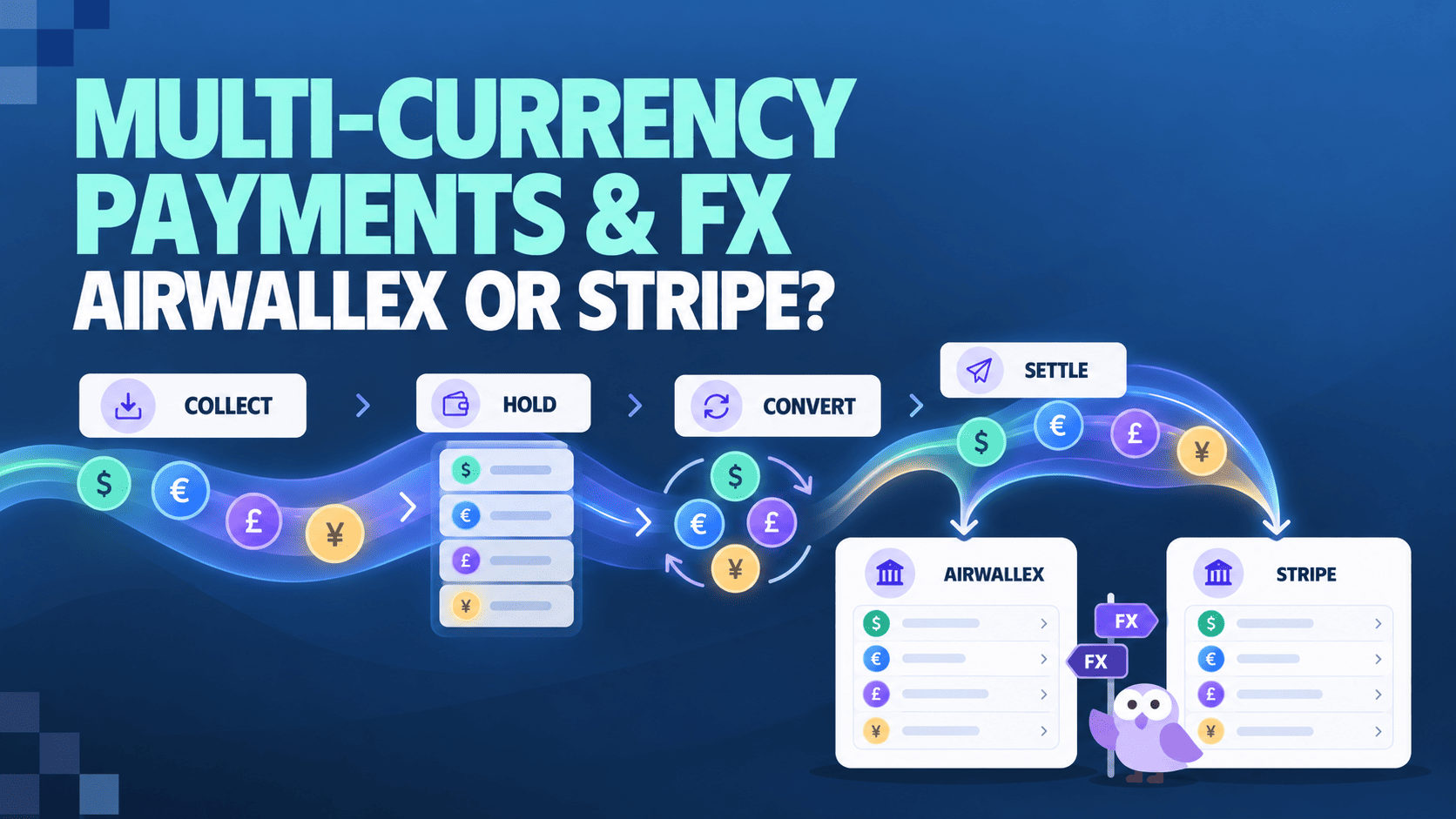
Airwallex has the clearer advantage when a company regularly receives, holds, converts, and spends several currencies. Its US pricing page lists like-for-like settlement in more than 20 currencies and FX at 0.50% above interbank rates for major currencies or 1.00% for other currencies. Businesses can also use local account details and make local or SWIFT transfers where supported.
Stripe supports charging in more than 135 currencies and offers multi-currency settlement for eligible accounts. It can also convert funds within a payments balance, and its pricing page lists instant currency conversion starting at 0.50%. However, eligibility and supported settlement currencies depend on the business country and bank account setup.
Map the full currency route:
If the business often pays from the same currency balance, Airwallex can remove an extra transfer or conversion. If funds settle into one domestic bank account, Stripe’s payment tools may matter more.
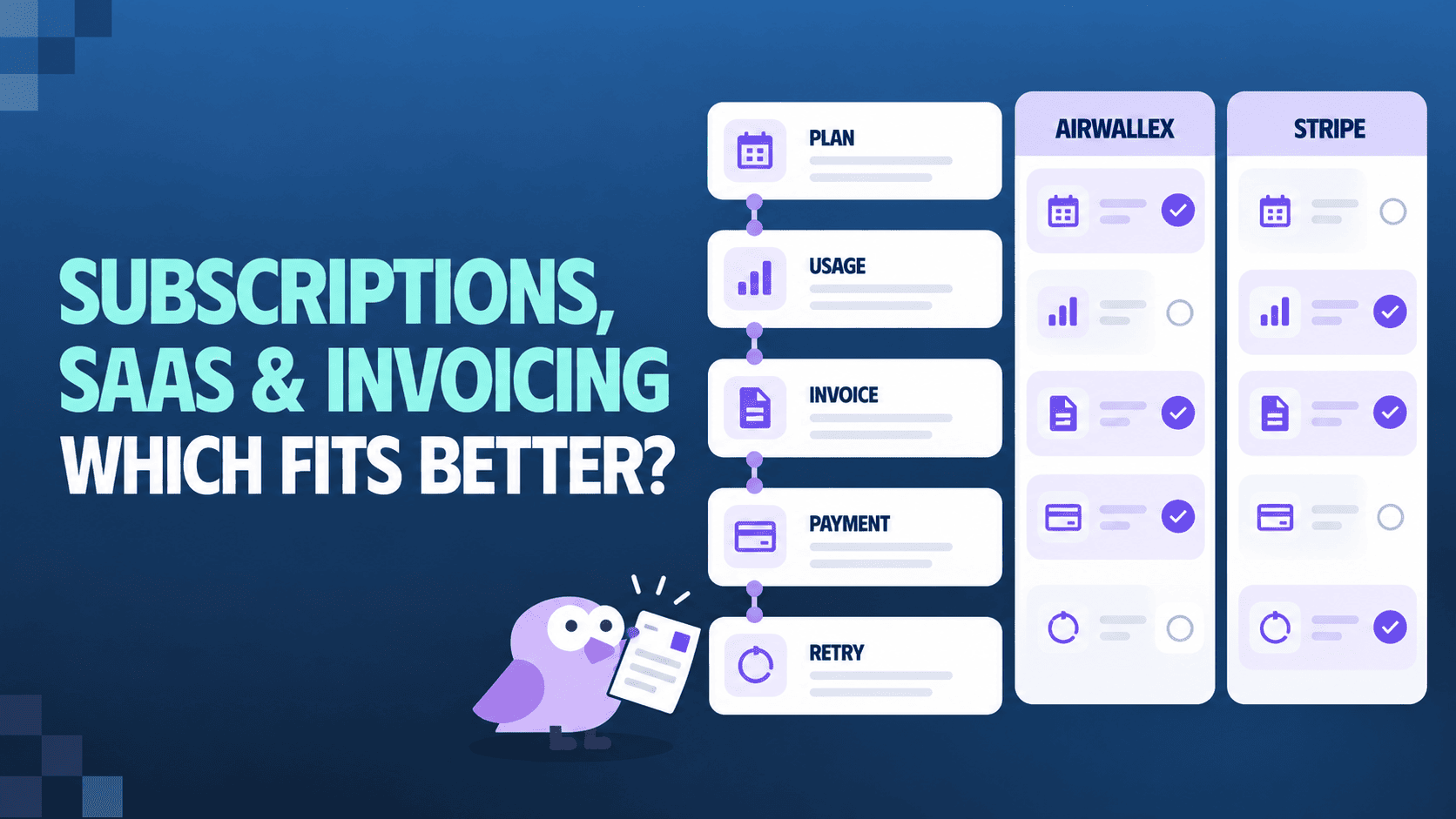
Stripe remains the safer default for complex recurring revenue. Stripe Billing supports subscriptions, trials, discounts, invoices, payment retries, customer self-service, usage-based billing, and different pricing models. It also connects with Stripe Tax and other revenue tools.
Airwallex now covers much more than basic recurring card charges. Its Billing product supports one-off and recurring invoices, flat fees, per-unit rates, graduated tiers, multi-frequency schedules, free trials, discounts, dunning, mid-cycle changes, usage metering, and hybrid pricing. Its published US fee is 0.50% per successful subscription or usage-based billing transaction.
The decision comes down to depth and workflow. Stripe is a strong choice when billing logic is central to the product and the team wants an established ecosystem. Airwallex is compelling when the same SaaS company also needs multi-currency collections, international supplier payments, and global finance operations in one account.
Tax requires a separate check. Both Airwallex and Stripe now list automatic tax calculation products, but supported countries, registration workflows, filing help, and merchant-of-record services differ. Neither a payment gateway nor a calculation tool automatically removes every tax duty. Confirm where the business has obligations and which party remains responsible for registration, collection, filing, refunds, and customer support.
Both platforms support low-code and custom setups. Airwallex offers payment links, hosted and embedded checkout options, mobile SDKs, APIs, and ecommerce plugins. Its payment-method documentation shows support across platforms such as Shopify, WooCommerce, Magento, and BigCommerce, although each method has its own integration limits.
Stripe offers Payment Links, hosted Checkout, Elements, mobile tools, APIs, and many third-party integrations. A team can begin with a prebuilt page and move toward a custom flow without changing processors.
Without a development team, compare the actual no-code workflow: creating a link, issuing a refund, finding a failed payment, exporting a report, or updating a subscription. For a custom product, test the sandbox, webhooks, error handling, and migration tools.
Stripe has the stronger established offer for in-person payments through Terminal. Airwallex’s point-of-sale availability is market-specific; its US site currently marks POS payments as coming soon. Retailers that need one system for online and physical locations should verify hardware, countries, card-present pricing, and offline behavior first.
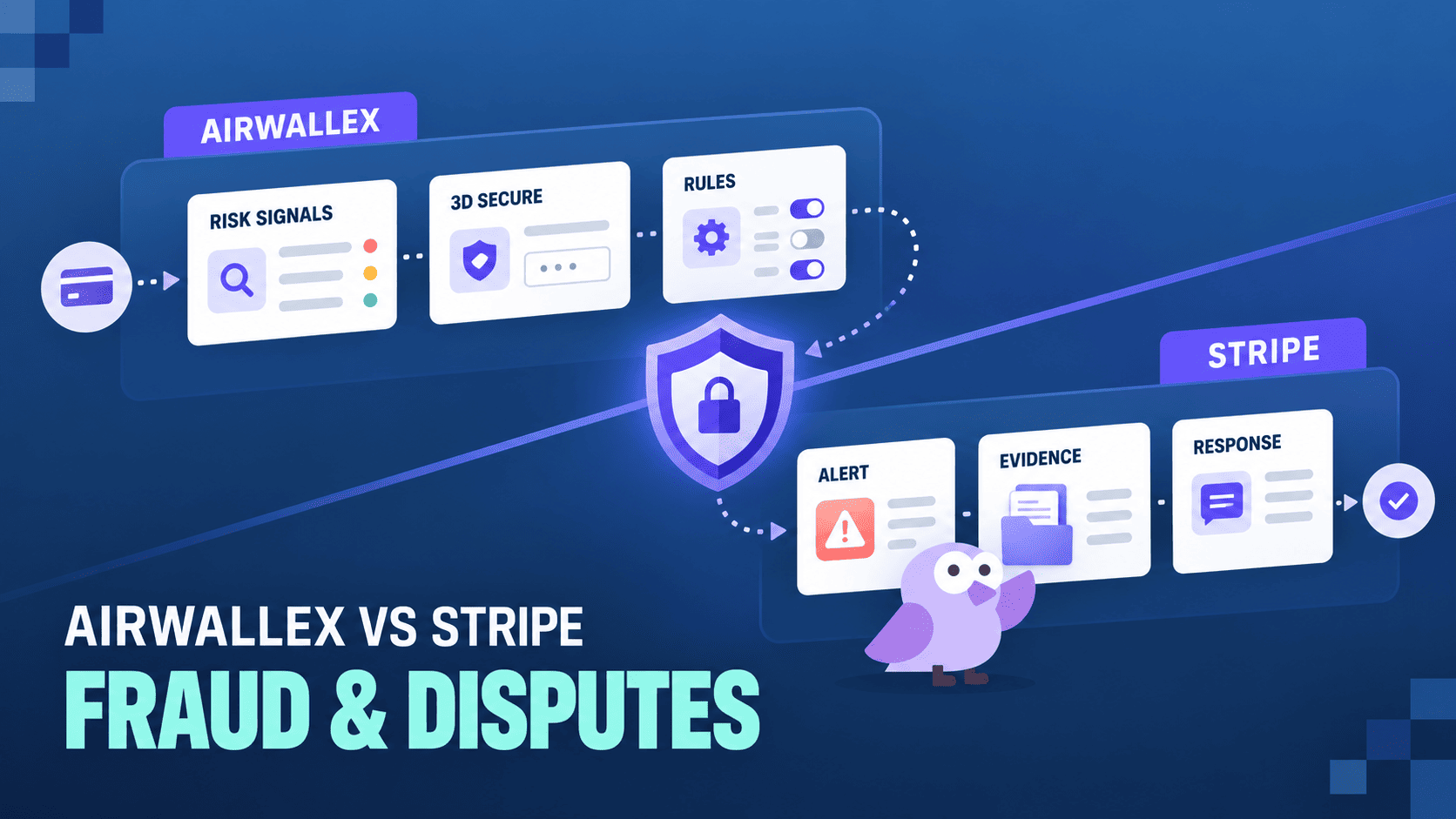
Stripe includes Radar Lite with standard payment pricing and offers paid Radar products for more control. Teams can use risk signals, rules, 3D Secure, reviews, and dispute tools within the Stripe environment. Stripe also offers Smart Disputes, but its published US fee is 30% of the disputed amount for each dispute won, in addition to the applicable dispute-received fee.
Airwallex provides a payment fraud engine, adjustable risk thresholds, device tracking, 3D Secure, attack detection, payment optimization, and dispute management. Its AI Dispute Automation can recommend whether to accept or challenge a dispute, pre-fill evidence, generate a card-scheme-compliant defense report, and support one-click submission. If the tool wins a challenge, Airwallex charges a success fee equal to 25% of the disputed amount, capped at $200. Availability may vary by account, product, and market.
Do not judge fraud tools only by blocked transactions. Monitor authorization rate, false declines, chargeback rate, manual review time, and net loss together.
For disputes, test the daily workflow. Staff need to see the reason, amount, deadline, order, fulfillment details, customer communication, and evidence without rebuilding the case from several systems. This is especially important for Shopify merchants using more than one payment provider.
A payment platform can process the transaction, but a Shopify merchant still needs clean fulfillment records and a reliable dispute process. Shipment details may live in Shopify, carrier data in another system, and chargeback deadlines in separate payment portals. That separation creates repetitive work and makes urgent cases easier to miss.
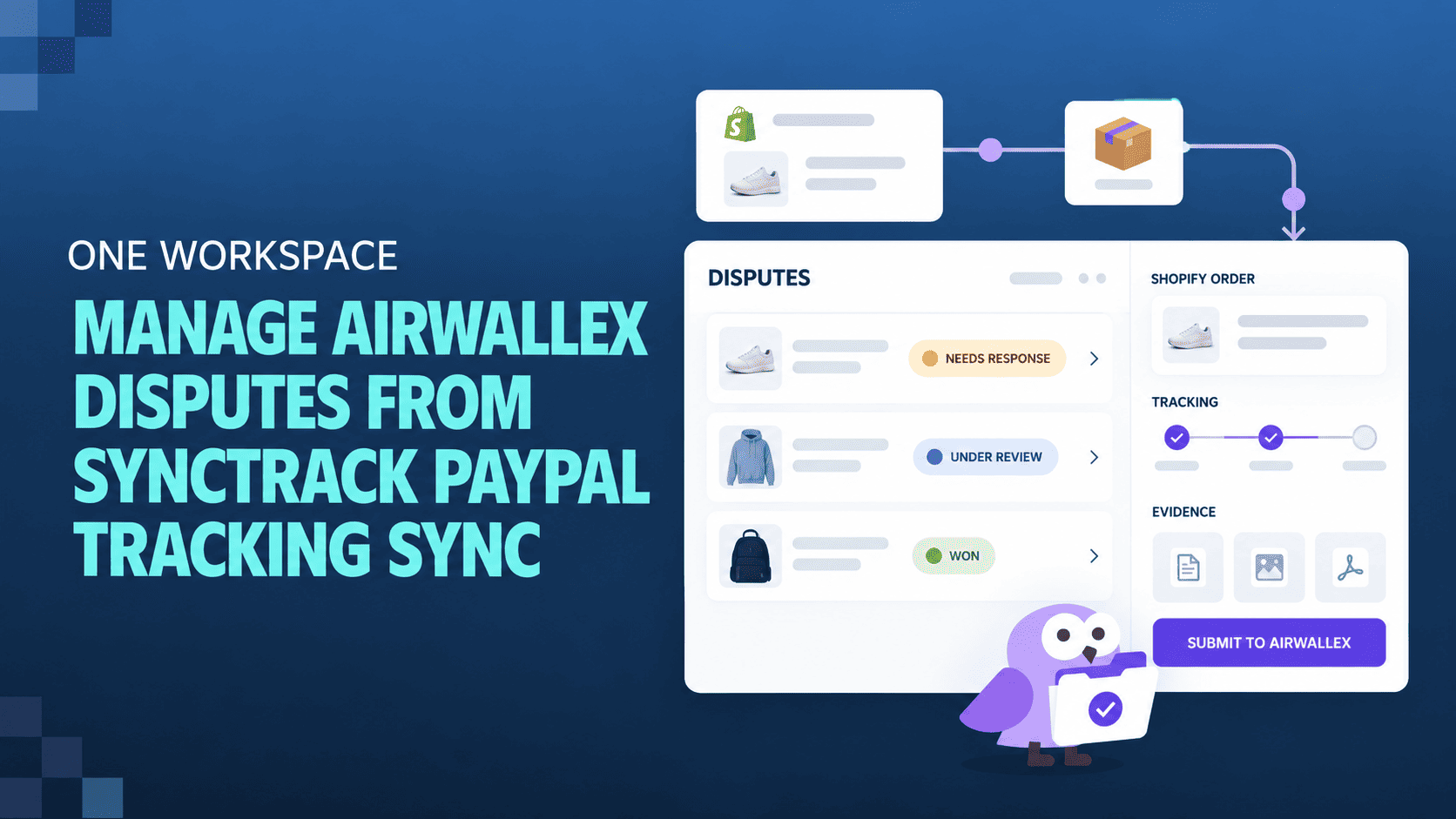
Synctrack PayPal Chargebacks works with both Stripe and Airwallex, although the available workflows differ by gateway. For Stripe, Synctrack can automatically send Shopify tracking and fulfillment details, support multiple accounts, and bring dispute handling into its dashboard. Merchants can also manage disputes and chargebacks from PayPal, Shopify Payments, Klarna, Afterpay, Adyen, and other supported gateways in the same place, with deadline reminders and one-click evidence auto-fill.
Thanks to Airwallex Dispute Management in Synctrack, merchants can connect multiple Airwallex accounts and view each dispute’s amount, reason, status, deadline, outcome, and linked Shopify order. From the same dashboard, they can accept or challenge eligible cases, pull carrier and tracking details from Shopify, check evidence requirements, upload files, and submit a response. Synctrack checks for updates every ten minutes by default, while an optional webhook enables near-real-time updates.
This gives Shopify merchants a more consistent workflow whether they choose Airwallex, Stripe, or use several payment providers. Instead of rebuilding every case across separate portals, the team can keep deadlines, order data, fulfillment proof, and evidence in one dashboard. Synctrack does not decide the outcome or guarantee a dispute win, but it can reduce manual work and make time-sensitive cases easier to manage.
Stripe is usually the better fit when:
Airwallex is usually the better fit when:
Yes. The platforms are not always an either-or choice. A company might use Stripe for a mature subscription product while using Airwallex for multi-currency accounts, FX, supplier transfers, or expenses. An ecommerce business may route payments by market or keep a second processor for specific local methods.
Using two providers can improve coverage and reduce dependence on one system, but finance must reconcile two sets of payouts, refunds, fees, reserves, and disputes. Add a second provider only for a clear market, method, or workflow. Define how orders are matched and who owns each dispute deadline. For Shopify stores, Synctrack can reduce fragmentation for tracking and disputes across Stripe and Airwallex.
There is no single winner in the Airwallex vs Stripe comparison. Stripe is a strong fit for businesses that need flexible payment infrastructure, advanced subscription billing, marketplace tools, and deep developer control. Airwallex makes more sense when the business also needs to hold multiple currencies, reduce unnecessary conversions, pay international suppliers, and manage global spending from one platform.
Before choosing, map how money moves from checkout to settlement and compare the total cost across processing, FX, billing, payouts, and disputes. Shopify merchants using either provider can also use Synctrack PayPal Chargebacks to keep fulfillment data organized and manage supported payment disputes from a more centralized workflow.